Showing posts with label reviews. Show all posts

Monday, July 28, 2014

Review and Giveaway: aDorn Designs.

Update: this contest is now closed! Congratulations to the winner - Kristina!

Y'all know I love my diabetes accessories, and I will not admit de-tweet (groan, I know, sorry) even when a manufacturer discontinues a favorite. So where can one now look for a stylish, secure, coated-fabric case for their diabetes paraphernalia?

Oh, I know exactly where:


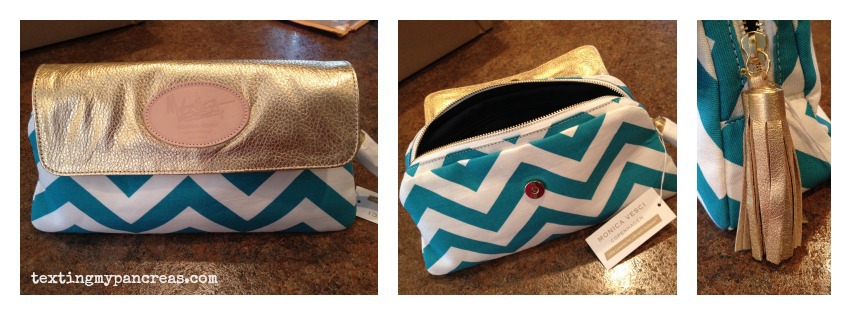
LeAnn from aDorn Designs just came out with a new diabetes bag called the "Elite Collection" clutch, and was kind enough to send me one for review earlier this summer. The condensed version is that while the interior could be improved slightly, this is a pretty solid bag that I plan to keep in my regular rotation. 


Huzzah:
  • It has plenty of room for my Verio meter, vial of test strips, lancing device, Humalog pen and needles, and other random bits
  • The outer material is ideal for meter bags: a coated cotton fabric that is unfazed by blood smears (seriously, love this fabric, can't say enough good things about it)
  • Several interior zipper compartments of universal sizes, like so:
  • Reasonable price point ($35)
  • Exteriors that feel modern/stylish/incognito instead of medical/utilitarian/obvious


Could Be Huzzah Someday:
  • While the clutch was rather lumpy-looking for the first day or so of having my stuff in it, the exterior eventually realized what was happening and chilled out - it's only super-lumptastic for the first day or so and then things stretch out (this is probably just a characteristic of the fabric and not a flaw in the making of the bag)
  • Slightly bigger than what I'd personally want to use on a daily basis, but everyone has different tastes so this really should be more of a "heads up" than a not-so-good
  • Let's make the interior fabric more stretchy, as to hug things a little better

If you'd like to claim one of these clutch bags for your very own, you are in luck! I am giving one away! You can pick from either of the designs shown above, and will need to respond to the eventual email I'll send you with a shipping address. Open to err'body, not just U.S. residents. You can earn up to two entries, using the Rafflecopter widget I have below: one entry for leaving a comment on this post that tells me why you want to win (and who you want to win for), and one entry for liking the aDorn Designs Facebook page.


a Rafflecopter giveaway


And if you'd like just to straight-up purchase one, LeAnn has kindly created a discount code for Texting My Pancreas readers that will deduct 15% off of your entire order: enter 15off at checkout. Go browse!

Disclosure: aDorn Designs sent me a free product for review, and to keep/use afterwards. I agreed to share whatever my thoughts would be here on TMP. I was not paid for this review and my opinions, thoughts, and photo text enhancements are, as always, solely my own.

Thursday, February 27, 2014

Review: Balancing Diabetes.

Oh wow, I thought. She was diagnosed the same year I was, at the same age - what are the odds?

I very clearly remember the first time I clicked over to Kerri's blog in 2009. It was this post that hooked me, and the realization that I wasn't the only one who was making mistakes and chiding themselves for not planning ahead, for sometimes dosing blindly and hoping for the best, for just wanting to live their life without the constant worry of "Did I bring...?" or "What if....?" looming overhead. She was talking about the real life side of diabetes; a side I had been keeping to myself. I hadn't realized until I stumbled across her that I longed to find someone to whom I could relate - how I felt, what I feared, what I celebrated, all of it. (And here she was!) Her words and admissions and analysis of this real life began to help heal some wounds I hadn't even realized were there. She was the gateway drug that led me to find the diabetes online community I love so much and depend upon.

So, you'll have to forgive me: I'm a wee bit biased when it comes to Kerri Sparling. 

Is this an objective review? It is not. She's my friend, and I'm a fan of what she does and who she is. I could say 10,000 good things about her and I'm sure I still would miss something.

What I do want to tell you is this: if you're already a fan of the wit, wisdom and wordsmithing magic that Kerri is known for, Balancing Diabetes will not disappoint you one bit. If you're looking for a variety of viewpoints on a variety of topics surrounding that real life with diabetes I mentioned - you will find all of that here. And if you or someone you love has diabetes but you've never heard of Kerri Sparling before, you need to fix that. Right now. I'll wait.

One of the things I admire about Kerri, and I've watched her do it time and again in a number of different situations, is that when the (well-deserved) spotlight shines to her, she grabs it and turns it to those around her. She walks the talk when it comes to altruism and the importance of a variety of voices being heard.

In Balancing Diabetes: Conversations About Finding Happiness and Living Well, she recounts many of her own experiences and thoughts as they relate to a life with diabetes: early memories of her diagnosis; the cruel wrath of a grade school bully; dating and relationship; her pregnancy and delivery of her daughter, and then motherhood; fitting diabetes devices into daily life; travel; the list goes on. She didn't stop there, though. She includes the thoughts of around 40 other people affected by diabetes (disclosure: I am one of them) to round out each chapter, and I loved the conversational tone it created. 

It takes a lot of courage to be as vulnerable as Kerri has been in this book, and that vulnerability is exactly what allows us, as readers, to connect with her so deeply. I hope you'll order a copy or twelve - it's a wonderful read.


You'll find Kerri's book, Balancing Diabetes: Conversations About Finding Happiness and Living Well, on Amazon, as well as the Barnes and Noble website. It also has a Facebook page you can like. I'm sure she wouldn't say so herself, and will possibly be embarrassed that I'm just flat-out asking for your help here, but I imagine it would be helpful if you'd leave a review on Amazon or maybe on the Barnes and Noble site, too, after you've read the book. Nudge nudge.

More on that disclosure: I was provided (free) with both a digital and physical copy of the book, and I am a contributor. I was not paid to write a review (or to contribute to the book, for that matter), but I consider it some karmic payback for all of the ways in which Kerri has helped me over the years, whether she realized it or not. 

Friday, January 3, 2014

Review: Asante's Snap Insulin Pump.

Disclosure: This review was written by me, and was not edited or approved by Asante. I was not monetarily compensated for this review, and opinions are, as always, my own. Also, I must be on a Kristin Wiig kick because I feel a little like Aunt Linda with all of these 'review' posts. "I give it four 'BEEP BOOP BEEP!s!' and an 'Oh, Brother'!")

In my recent search for a new insulin pump, I was able to try out Asante's Snap for a few weeks. (They offer a free trial to those who qualify.) I mentioned this in an earlier blog post, pointing out some "first impressions".

I know the screen looks hard-to-read here - rest assured, this is the
"dim" screen, right before it falls asleep. The screen is much brighter
while you're interacting with it.

Now that I've had a good amount of time to educate myself on how it works, and specifically how it would work for me, I'd like to share a few thoughts.

So, if you don't mind dedicating 14 minutes of your life to watching me talk, here's my review:


(And if you don't want to/can't watch the video, here's the take-away: I really loved wearing it and how the Snap functions, but it's missing a few items on my "Top Ten" of insulin pump features, so in the end I didn't choose to buy it. It's a great pump that I would recommend to others, and who knows - maybe future iterations can include the features I missed.*)

I also did a shorter video showing just how the super easy cartridge change-outs works, since that's one of the main features Asante likes to point out about the Snap. I found it to be as simple as they make it seem.


If you'd like to try out the Snap too, contact Asante and see what's up.

Now for a few days without blogging. Vlasnik OUT!

*Two things: the bit about not having a touch bolus option? I was uninformed! The Snap can do that; I just didn't have my demo pump programmed to do it. And second: the "no software" problem has now been resolved; Snap is compatible with Diasend software. Huzzah!


Friday, December 6, 2013

First Impressions: Asante's Snap Insulin Pump.

A very large box arrived on my doorstep and after spending a couple of hours on Skype with a CDE, I'm hooked up to the Snap insulin pump, made by Asante. I'm doing a four-week trial, which may be an option for you, too - if you'd like to try it yourself, I suggest you go inquire to see if you qualify. (I want you to think about that for a minute - they're letting patients try their pump, for free, for four weeks. Four! Weeks! You have to be pretty ballsy confident in your product to offer that.)

This pump looks (and acts) a little different than what I'm used to, so I wanted to post a few more pictures than what I put on Instagram last night, and share a few thoughts. I've only been wearing it for about 12 hours, so these are definitely "first impressions". 


Hooray:
  • The pump utilizes pre-filled, glass insulin cartridges which is great for a few reasons: no wrestling with air bubbles trying to transfer insulin from vial to reservoir, no degradation of insulin due to being in a plastic reservoir, and you actually get to use all 300 units of insulin in the cartridge because the cartridges are filled to 315 units, and the prime only uses 15 - 16 units.
  • Less parts - just a controller (the half of the pump that has all of the buttons and screen), the pump body (the part that houses the cartridge and battery - which means you get a new battery every time you change out the insulin), and the infusion set/tubing/connector. 
  • Yeah, that auto-prime thing is pretty cool. It made me guffaw.
  • You know how with an Animas pump (and maybe others, I don't know), when you want to bolus for carbs, you tell it how many carbs, it suggests a bolus, and then you have to dial up to that amount, confirm it, and then it boluses? There's no bolus dialing with this pump. Let me say that again: THERE IS NO BOLUS DIALING. I tell it how many carbs, it tells me a bolus suggestion, and I just tell it "yep" and it starts delivering it. 
  • And you know how Animas pumps (and Medtronic, probs) have that cartridge cap that sticks out from the pump, where the tubing comes from - and sometimes when you sit down it jabs you in the stomach? Yeah, no cap on the Snap. Woo!
  • The buttons have a very satisfactory resistance to them. Do you know what I mean? It's a tactile thing - I want buttons that really depress and then pop back when I let go. These feel nice.
  • When I press the left-most button, an empty screen reminiscent of CGM graph appears. "Oh", I thought, "there must be some future integration efforts in the works". Well, that is true ("We'd love to be integrated with Dexcom") but also this graph plots all of the blood sugars you've entered for the previous 12 hours. (WHAT?!) Awesome!
  • Basically, there are a lot of little thoughtful things designed in this pump, and I'm still discovering some of them. It's made me smirk with delight a few times already, which is a pretty lofty achievement for a medical device.
Are you serious:
  • The pump's appearance... leaves something to be desired. Someone asked if "they are doing the 'hipster' pump look, cause it's really doing the old look/new gadget thing well". As you can see above, it's a pretty long pump, too. I'm not sure how pump-in-the-bra is going to work; I'll report back.
  • The insulin-dispensing noises remind me of the noise your computer makes when you eject a CD. It's kind of loud.
  • This is a huge one for me: the pump does not have a vibrate option for alerts and alarms. In my 8 years of pumping, I have always had my pump set to "vibrate only", so this is kind of upsetting for me. The sounds are adjustable, so I have it on the lowest setting, but it's going to beep every time I bolus, etc. I am really not pleased about that. When I asked about it, I was told that when they did their market research they found that people wanted a "lighter", less heavy pump - and taking out the vibrate capability helped shed some extra ounces. Let me tell you: I'd gladly wear a pump twice as heavy if it meant it could be QUIET, but maybe that's me. As the person who is wearing this thing all the time and in different social situations, I need to be the one who decides when I want to be out-and-proud, and when I want to be discreet. (Update: I've bolused a few times with it now and have the volume set to the lowest level. I generally put my pump back in my pocket while it's bolusing, and have noticed with the last two that I can't really hear the "end bolus" beeps. I am less worried now, but it may be more audible if you're just wearing the pump in a holster at your waist.)

I'll share more as Mr. Snaps and I go along, and try to avoid saying "aw, snap!" in every post about it.

No guarantees though.

Disclosure: Asante sent me a Snap insulin pump to try, for free, for up to four weeks. I am offering my thoughts and feedback to them and will be writing about my experience as I go, because that's what I want to do. I am not receiving financial compensation for my reviews, and opinions are, as always, my own.

Thursday, December 5, 2013

My Experience With Medtronic's Enlite CGM System.

Because this post seems to be getting a lot of traffic via Google searches, I want to update it with a couple of thoughts:

  1. I am very aware that trying a medical device for two days may not be sufficient enough time to form a well-rounded opinion on it, and you should remember that while reading this. I wasn't willing to stab myself a seventh time just for blog fodder.
  2. Many other people are writing about their experiences with the Enlite CGM and the 530G system, and I hope what they're sharing will be useful to you. Christel, Karen, Scott, and Jeff are a few that come to mind.


tl;dr: I tried the Medtronic Enlite CGM and my experience was reminiscent of an internet meme.


I did a shorter-than-I-envisioned trial with Medtronic's new Enlite CGM system this week. Medtronic's marketing team contacted me after reading my post about looking for a new insulin pump and asked if I would like to try out the 530G with Enlite system, to aid my decision process.

I thanked them for the offer, but reiterated that I have no interest in switching to Medtronic's pump (as I mentioned in that post) but the opportunity to try out the new Enlite sensor intrigued me a bit. I've only ever been a Dexcom customer when it comes to CGM technology, and while Dexcom's Seven Plus, and now the G4 Platinum, come with their faults... I've grown very fond of them. It occurred to me that my opinion/crush/moderate-fangirldom of Dexcom's CGM wasn't really backed up by a well-rounded education - how could I know it was so great if I had nothing to compare it to? - and so would Medtronic maybe just let me try the sensor part of the system?

Yep, they would.

On Monday afternoon I went to my endocrinologist's office to meet with my local Medtronic rep and get hooked up to the Enlite CGM. Because Enlite doesn't have a separate "receiver" like Dexcom does, this meant that for two days I was wearing an Enlite sensor on my body (in addition to a Dexcom one) and then carrying around a Medtronic/Minimed pump that had no insulin, cartridge, or tubing in it - an empty pump whose screen let me view the CGM data (in addition to my Animas Ping, which I was actually pumping with). WEAR ALL THE DEVICES!

My initial impressions in those first few minutes of setup were good: oh, that sensor looks smaller than the one I remember seeing before; the wire part that stays under the skin feels a lot more flexible (read: comfortable) than the previous model; the real estate required to wear it is less than a Dexcom sensor; the rep said the Enlite is 31% more accurate. ("31% more accurate than.....?" "Our previous CGM." "So, still not as accurate as a Dexcom G4 Platinum sensor. Got it." ::awkward transition to next topic::)

We used the "improved" insertion device; a block of gray plastic with a bright green button on the side, whose main feature was that the CGM needle would not be visible while inserting the sensor - a plus for squeamish, I think. The insertion went smoothly - I was delighted to remark that the needle barely hurt (I would say it's comparable to what I feel with a Dexcom sensor insertion), and with a nurse's help, we got the inserter removed and the sensor taped down. After a few instructions on menus, alarms, and settings - I was off!


Within the first hour, my Enlite receiver was vibrating with a "LOST SENSOR" message. I think I must not have paid enough attention to the instructions, because it took me several tries to get the right combination of buttons (down arrow, esc, act) pressed in order to clear the error message and get the "pump" to stop vibrating. I called the rep to let him know, and he walked me through how to "find" the sensor again. The callibration period (two hours, just like with Dexcom) continued.

The Medtronic rep and I texted back and forth periodically throughout my trial, troubleshooting as needed. His availability was both reassuring and appreciated.

Throughout the rest of Monday evening, I watched the graph bounce higher than what my meter or Dexcom receiver were showing. Overnight was less than restful due to the combination of high alarms and "WEAK SIGNAL" alerts that buzzed from the Medtronic receiver every time I rolled onto the Enlite sensor.

Tuesday morning found more of the same - frequent error messages of "WEAK SIGNAL" or "LOST SENSOR", so when the rep texted me again to check in, I sent told him of the error messages and sent him a photo comparing the Enlite screen with that of my Dexcom and my meter.


I wasn't sure, and neither was he, why this sensor wasn't getting with the program. I've worn Dexcom sensors in this same area before with great results, and I wondered if perhaps the Enlite needed time to "marinate", just like a Dexcom sensor would - the first 12 to 24 hours are always off! (And to be fair, with time it did get more matchy-matchy with my other devices.)


But with so many error messages it seemed to suggest that either the sensor itself was bad, or perhaps I didn't have enough interstitial fluid in that location for proper readings (I really don't think that was the case). We made a plan for me to stop in the next day to swap out the buggy sensor for a new one.


I swung by my endo's office Wednesday after work; this time the rep was not there, but I met with a nurse I'm familiar with. We loaded up the insertion device, and she left the room so I could have some privacy. I lined up the device with a spot on the right side of my stomach, clicked the button and then let go (the letting go is what makes the needle plunge into you), waited five seconds, then once again pressed the button and lifted the insertion device straight off.

And the sensor came right with it.

"Well, crap!", I said. Not wanting to admit defeat, I used my finger to push the sensor back and click it into place, so that I could try again (DO NOT TRY THIS AT HOME). CLICK! SHUNK! CLICK! I lifted it once more.

And the sensor came right with it.

"Noooo! What?" I tried for a third time, but now I asked the nurse to come back in the room. I did the click-and-shunk before she came in the room; all she had to do was help me remove the insertion device.

"Make sure you're pressing down with two fingers.... and then just lift straight off." I did.

And do you want to guess how that went?

She looked just as perplexed as I was. "I've never seen that happen! Let's get a different sensor." I switched to the other side of my stomach, just in case. Loaded it up, click, shunk, click, lift.

Sensor came with it.

Let's try another new sensor! (So now we're on the third sensor try of the day, and the fifth insertion attempt.) Back to the right side of my stomach, because the left side HURT when that needle went in.

Load, click, shunk, click, lift, OMGWTFBBQ.

I was now bleeding out of five different holes in my stomach, with no new hardware to show for it.

"I think we're done here", I told her. I peeled the two-day old "bad" sensor off, and proclaimed my trial period over. (The sensor is approved for six days of continuous use, so I could have worn it the whole week.)


In summary, I think the insertion device isn't very well designed. I understand the importance of "hiding" the needle, but either the sensor needs a wider adhesive area or you need to be able to actually touch the tape (the inserter completely covers it when using it) to hold it down while lifting off the inserter.

And when you combine this problem with all of the WEAK SIGNAL! and LOST SENSOR! alerts I got, the artificially high results and not-always-matching trend arrows, and the tiny black-and-white screen...

My skepticism going into the trial was not unfounded. I'm still firmly planted on Team Dexcom.


Tuesday, December 3, 2013

Test Driving the VerioSync.

Disclosure: I was contacted by LifeScan, the makers of the One Touch VerioSync, who asked some people in the diabetes online community if they could send us the meter (for us to keep) ahead of its commercial launch so that we could try it and share our experiences online. I am not financially compensated for any reviews, and opinions are always my own.

If you follow me on Instagram or Twitter, you may have seen me share some photos of a new One Touch meter called VerioSync. I was able to see (a version of) this meter at last year's Friends For Life conference and had been looking forward to its release. (The bad news is that its still not commercially available - the materials sent with the meter indicate they expect that to happen in the first quarter of 2014.) While I've only been using it for a week or so, I seem to already be feeling a moderate amount of warm fuzzies towards it.


The "big deal" with this one is that the meter automatically syncs your readings with the complimentary One Touch Reveal app without needing to plug anything in - it transmits over Bluetooth.

Some first impressions:


The Good:

  • The results I've had have been very happy-matchy with my previous Verio meter, as well as my Dexcom G4 Platinum data. I like consistency.
  • Never needing a battery change - you just plug the thing in via USB cable (included). Supposedly, battery life lasts up to two weeks - I'm guessing it will be more like one, given how frequently I test.
  • It uses the same strips as the VerioIQ, which according to LifeScan are "covered at the lowest co-pay on the most health plans and are always covered by Medicare Part B". 
  • The meter is small, and could certainly pass for something not medically-related.
  • It has an app, and I don't have to do anything past keeping the meter close to my phone when testing to get it to transmit. 
  • Speaking of the app - it's easy to see at a glance how I'm averaging, what the distribution looks like (color-coded!), and any patterns that might be emerging. 
  • It has a light at the top! That doesn't sound like a big deal, but when you're trying to test without waking up your four month-old... it's a big deal. This light isn't as big or bright as the VerioIQ's, but it's sufficient.

The "This Could Be Better":

  • The battery drain on my phone - OMG. 
  • Where'd my big, beautiful color meter screen go? :(  I realize most of the coolness moved to the app, but if you're using this as a stand-alone meter, there's much to be desired display-wise.
  • It's weird that this meter has only one button, on the right side. 
  • The app isn't entirely intuitive to use (took a few days, and several tweets, to finally figure out how to share the logbook), and my stubby fingers had a tough time setting up the low/high pie chart specifications.
The accuracy (compared to the VerioIQ meter and Dexcom results I already trust) I'm seeing has me feeling pretty comfortable with this one, and when I pair that with the realization that I could be paying half as much for test strips by switching back to One Touch meters, I come to the conclusion that I'm probably jumping ship on my iBGStar for a while.


Friday, May 31, 2013

Adorably Functional.

You guys know how much I love my diabetes accessories, right? I mean, if I have to lug around all of this medical crap it might as well be packaged in a way that doesn't scream "HEY OVER HERE DIABETES". I can't tell you how many small cosmetic bags I've bought for this purpose, and while those work okay, it's nice to use something that has compartments designed specifically for the stuff I'm putting in them.

Man, wouldn't it be great if someone could fuse cute modern design with the functionality of the plain black cases our gear comes with? Wouldn't it be lovely if someone mistook your diabetes bag for just a "really cute bag and where did you get that"? Wouldn't that be Super Awesometown?

Can you see where I'm going with this?

Check out what I've been using for the past couple months, because you could win one of your very own:


The creator of this adorbs clutch is Monica Vesci, who lives with diabetes herself. Frustrated that she couldn't find a bag for her diabetes stuff that suited her needs, she launched her own business earlier this year. In her words: 
"Women should not have to be embarrassed by an ugly black medical supply case while feeling insecure about their diabetes. My vision is to provide innovative, affordable luxuries for people living with diabetes. I’d like to empower women by helping them to feel more beautiful by taking care of their diabetes with style and pride."
I've enjoyed using this clutch and have a few thoughts to share on it, but before we get to the bags themselves, let's take a few minutes to meet the woman behind them:

Kim: Hi Monica! Can you tell us a little about your own personal experiences of living with diabetes?

Monica: I was a senior in high school when I was diagnosed with type 1 diabetes in 1994. I had been ill for several months leading up to the diagnosis but it never occurred to me that my symptoms could be signaling a chronic disease. I had never heard of diabetes and I didn’t know anyone who had it, so it was a total shock. 

I came close to lapsing into a diabetic coma and was hospitalized for many days as insulin was pumped into me, working its magic. I was introduced to my diabetes self-care routine including carb counting, exercise, insulin dosing, blood sugar testing and a seriously restricted diet (no more Oreos?!) I took my diagnosis like a champ, accepting everything from the beginning and asked what I needed to do. Soon I was giving my own injections and thought “this isn’t too bad. I can do this”. I returned to high school and graduated. 

Determined to not let diabetes stop me, I left for college in upstate New York and met my local team of diabetes physicians, nurses and educators. I soon realized, however, that trying to control my diabetes was much more difficult than I had originally thought. I wanted to eat pizza, drink beer and go to the cafeteria at odd times like everyone else. But that would have a disastrous effect on my health. I was sleeping a lot, missing classes and defiantly eating things I was told not to eat. I hated diabetes!

I became depressed and withdrew from my friends and social activities. Taking medical leave, I returned to Philadelphia to get things under control. My physician explained I had accepted the stages of diabetes in the opposite order. People typically go through denial first and acceptance last, but I did the reverse. I accepted it right away and after a year I was in denial. 

A brief regimen of antidepressants and therapy helped me to get on with my life in a new, healthy way. I earned my degree in Fine Arts from Chestnut Hill College, in Philadelphia, and after six years of living with diabetes, I was finally accepting it. I was back in control.

How are you doing now?

My husband and I began pregnancy planning in January 2013. After years of multiple injections, I decided to try an innovative new pump to promote my potential health and that of our future child. Armed with research from my doctor, support from my team at Steno Diabetes Center and encouragement from my fantastic husband (who is a diabetes researcher), I am now wearing the Animas Vibe pump with the built in DexCom CGM to avoid having two medical devices with me all of the time. 

This has been one of the best decisions in my diabetes care so far. I love this pump and with my A1c where it is now we are well on our way to planning for pregnancy. It’s a very exciting time knowing that I am at my healthiest and ready to start trying for a little one.

Best of luck to you on your journey to pregnancy! (And could you sneak me one of those Vibes?) So what lead you to want to create your own bags, and how do you envision them fitting into PWD's lives?

I’ve always had a bit of an entrepreneurial spirit. I love designing and I was tired of finding my used test strips and lancets all over the house, in my clothing, in my HAIR and in the bottoms of my purses. I wanted a more practical and safer way to carry my daily diabetes supplies, and, most importantly, a place to safely and discreetly dispose of hazardous waste while on the go. I hated digging into my bags to find something only to come up with a handful of used test strips and needle pricks. I wanted to carry my supplies with style and grace. There are other lovely products on the market but I feel they are geared mostly for children or young adults and I did not find them suitable for my needs.

The Camino Clutch is unique in that it houses a personal, removable sharps container in a discreet way. It allows the user to safely and securely dispose of used test strips, needle heads and lancets in an unassuming and stylish way. The puncture-resistant container has a screw top lid that can be tightened once the container is full and the hazardous waste discarded according to municipality standards. [Editor's note: I wasn't sure how often I'd use this feature of the bag, but it really has come in handy for the times I'm doing a pump set change at work.]

This is a classy-looking Clutch Purse with enough room to carry your glam stuff and your daily diabetes supplies. I designed it to make me and you feel beautiful with diabetes. Devoid of the standard medical kit velcro and elastic, the clutch can be carried on its own as a chic purse (perfect for running errands, a lunch date or a night out on the town) or thrown into a larger tote, gym or diaper bag.

Let's talk a bit about pricing, because while the bags are gorgeous, some may not find them as affordable as some of the other bags out there. How do you feel these differ from what already exists on the market, and how did you determine your price point?

We arrived at our current price point by adding up the cost of materials, production, transport and company operations. As a startup company, we are now learning that our price point is in the higher end of what our clientele would want to pay for a diabetes supply bag. This is something we are working on because we strive to be a company providing affordable luxuries for people living with diabetes.

Our clutch differs from others with on-trend style geared toward women and not children; the inclusion of the sharps container; high quality materials and production in the U.S. I began with an idea of a high quality bag produced in the U.S., so we chose a skilled, small-scale manufacturer in Brooklyn, NY. Although production time is a bit longer and production costs a bit higher, we chose this method because the quality is top notch. 

Anything else you'd like people to know about you?

My parents and I are co-founders of “Ace For A Cure: Smashing Out Diabetes,” an annual tennis tournament, in Philadelphia, with all proceeds donated to the Juvenile Diabetes Research Foundation (JDRF) for Type 1 diabetes research. Our 8th annual tournament will be played on June 10, 2013. Our tournaments, thus far, have raised $250,000 for diabetes research.

This fundraising initiative was launched because I was concerned that we were not doing enough to support diabetes research. We decided to go with a tennis format because of our love for the game.  It is a grass court, doubles format, round robin tennis tournament that has expanded to two venues this year—the Germantown Cricket Club and the Merion Cricket Club.  If you’d like to know more about the event, become a patron, volunteer or donate a raffle gift, please visit www.jdrf.org/aceforacure.

Very cool. Thanks for sharing your story, Monica!

What I like about this bag: it's sneaky in that it doesn't *look* like a diabetes bag, it's clearly very well-made (it actually reminds me, in terms of design, construction, and quality, of a Coach bag), it has appropriately-sized pockets and loops, and the sharps container is pretty genius. While I personally would prefer the outer material to be a bit more sturdy/stiff (it softens up a tad with use), I suppose that's a good thing for when you need to cram a bunch of stuff in there. It's a very roomy bag that is even long enough to hold a Dexcom G4 sensor still in its packaging - impressive! (I should also disclose that this bag was provided to me free, for review.)

So where can you find these goodies? Here:

Web:            monicavesci.com
Twitter:         @MonicaVesci
Facebook:     facebook.com/MonicaVesci
Pinterest:      pinterest.com/monicavesci/

And how can you win a free Camino Clutch of your very own? (You get to pick the design, btw - and
you can also pick one without a flap, if that's your jam.)
  1. You need to be a person with diabetes, or their caregiver.
  2. To enter, visit monicavesci.com then come back and leave a comment below about the strangest/funniest/weirdest place you have found a used test strip, and which Camino Clutch you would choose if you won.
  3. You can earn an extra entry for following @MonicaVesci on Twitter. (Be sure to mention that you are following her on Twitter in your comment below, for your extra entry to count!)
  4. Entries must be posted by 11:59 pm CST Sunday night (6/2/13), and one winner will be chosen at random*. The winner will be announced Monday morning on this same post - so check back here! (I'll tweet and post on Facebook when the update goes live.)
Good luck to you!

*Limited to readers in the Continental U.S. only. Please do not leave your email or web address in the body of the comment. $139–149 USD total value. 

UPDATE: Congratulations to the winner - Jessi Panke!


I'll be contacting you shortly, Jessi. Thanks to everyone who commented for participating!

Monday, March 11, 2013

More Than Meets The Eye.

During last December's Give All The Things!, Donna at Tallygear offered to send me a free Tummietote belt (and, later, her case for the Dexcom G4 receiver). This happened before I knew I was pregnant, so the size I ordered wasn't intended to fit a baby bump.

But thankfully, this thing is stretchy as hell and lets me transform from "normal-looking pregnant lady" into "stealthy multiple-device-wearing pregnant lady" quite nicely.

Related Posts Plugin for WordPress, Blogger...

And not only is the stealthy part cool, but it also solves the "these pants have no pockets and I have to lug all of this crap around" problem.


The middle pouch (there are 3, and they velcro shut thoroughly, which I'm sure is helpful if you're one of those super active people) even has a window, which is super convenient for quick checks of a CGM graph or IOB on an insulin pump. It lays surprisingly flat, and with the mega-long maternity shirts (what is that, anyway?), it's not even a big deal.

Speaking of convenience, I need to invest is some shoes that don't require anything but sliding my feet into them, because reaching my feet to tie up sneakers is already getting kind of awkward.

Monday, February 11, 2013

Ginger.io.

(Alternate titles to this post: "Following Your Every Move [But Not In A Creepy Way]", "Stalking Has Never Been So Healthy", "Maybe I Should Just Get On With The Post Already")

I remember seeing the name "Ginger.io" at the Stanford Medicine X conference last September, but never really got a chance to find out what (or who?) it was. I made a mental note to Google it later, but never did... which meant I was really glad to see an email from them a couple of weeks back, explaining what they're all about. I think what they're working on is a really cool concept and could help a lot of people (and requires minimal effort from the user to gain the benefits), so I wanted to help spread the word.

[Kim]: Can you tell us a little about what Ginger.io is, and how it got started?

[Peter of Ginger.io]: Sure, Ginger.io is a small startup on a big mission to change how people living with chronic conditions connect through health information — using just an iPhone or Android phone. Our application uses the sensors in your smartphone to map the relationship between your behavior and your health — and turn it into insights.

Ginger.io is based on research that came out of MIT’s Media Lab, where Anmol, our co-founder, was pursuing a PhD in computer science with a focus in modeling human behavior patterns. While at MIT Anmol met Karan, our other co-founder and an MBA with a deep knowledge of the health care system, and together they set out to build a check engine light for human health.

How does the whole thing work, and how much information do you have to share with the Ginger.io app?

For the first month or two, we’ll focus on collecting data and learning how your condition affects your behavior. Once we have your behavior baseline, we’ll start delivering personalized health insights, provide insights into how the study community is doing, and allow you to better connect with your care team by alerting them when something seems out of place.

So what type of data do we collect? The first type is active data - this data is short surveys that our application will ask you to answer periodically. They are easy to fill out and ask general questions around your mood, exercise behavior, etc. The second type of data we collect is passive data through sensors in your smartphone. Passive data is general patterns around your calling, texting, and movement behavior. Our system does not collect any specifics (i.e. who you are talking to, what you said, where you went). All we gather is general patterns like “how many calls did you make yesterday” and “how far did you travel”. All of your data is fully HIPAA compliant and treated just like a medical record at the doctor’s office.

Sounds legit. So why do you think this will be helpful for people living with diabetes? What value will patients get out of using the app?

Many people living with diabetes often feel overwhelmed at the sheer amount of things they need to keep track of. Ginger.io tries to track behavior with minimal effort on the participants side and help them get the support they need when they need it. Participants will receive:
  • Personal insights into their health patterns — right away
  • Improved connection to their care team (after the first couple of months you can set up alerts to be delivered to your care team when something seems out of place)
  • Satisfaction that they’re contributing to science to benefit the diabetes community


Is this for people with all types of diabetes?

Our current study is targeting those with type 2 diabetes but we plan to release a version of the application for pre-diabetes and type 1 diabetes in the future. As such, we encourage anyone living with diabetes to sign up for the program and we’ll get them on the app whenever possible. [Editor's note: I downloaded the app a couple of weeks ago and while it's intended for people living with type 2 at this time, it has pointed out how far I'm traveling each day which is kind of nerdy cool and interesting.]

How can people find out more about you guys, and find the app?

Those interested can learn more and/or sign up at http://ginger.io/join/ddd/. For more general information on Ginger.io they can visit http://ginger.io/contribute-to-science/.

Friday, November 2, 2012

Breakthrough.

I recently finished reading, for the second time, the book Breakthrough: Elizabeth Hughes, the Discovery of Insulin, and the Making of a Medical Miracle, and I'm sure I'll reread it many, many more times. (Disclaimer: I received a copy of the book for free, when I attended the Lilly Diabetes Blogger Summit in May. No one asked me to write about it.)
In 1918, an eleven-year-old girl stands in the kitchen of her family's elegant townhouse gulping water from a glass with such ferocity that it runs down the sides of her face. It is her sixth glass. {Prologue}
If you live with type 1 diabetes, I highly recommend that you try to find a copy of this book. It's enthralling, educational, enlightening. It's emotional*, especially when read by someone who relies on insulin therapy. And yes, it is a difficult read at times. But for as many times as it is difficult, it is also inspiring and eye-opening.
On this day in April, [Dr.] Allen was to tell Charles and Antoinette Hughes that Elizabeth would not likely survive the summer. Her only hope was to completely surrender to his extremely onerous [starvation] therapy. {page 9}
Elizabeth Hughes was diagnosed with type 1 diabetes in 1918. Insulin wasn't discovered and made available to the public until 1922, and Elizabeth was one of the first people with diabetes to ever receive insulin injections.

The descriptions of Dr. Banting really colored in the story for me. I knew next to nothing about him as a person, nor how he came to discover insulin. If you live with (or care for someone with) diabetes, you really should hear how the idea came to him, and how hard he fought to prove its truth.
Banting's initial idea was neither original nor successful, but he persisted in it, and his persistence led to a solution that was both original and successful. He would say later that if he had been more familiar with the literature on the subject and had known about the previous attemps, he would not have pursued his idea at all. {page 63}
 Thank goodness for his aloofness.


I don't want to give too much of the story away if you haven't read it, but I will say that it's very difficult to walk away from this book and not feel incredibly grateful for the work of Banting, Best, and the rest of the insulin team at the University of Toronto. Breakthrough also, of course, highlights the work of Eli Lilly and Company (as it should) to get the extract produced safely and consistently, and into the hands of the people who so desperately needed it.
Eli Lilly and Company agreed to delay its own clinical work at Methodist Hospital in Indianapolis in order to supply extra insulin to Toronto until Connaught [a member of the insulin team] could recover the ability to make its own. {page 179}
Insulin was now not only readily available, but also affordable. Although Eli Lilly held the exclusive franchise of insulin production in the United States, the company was committed to keeping the price as low as possible so that it would be available to all diabetics. By the end of 1923 the cost of treatment per patient was frequently less than one dollar per week and seldom more than two dollars. {page 228}
Banting is painted as a driven, frustrated, and mostly socially inept man searching for his life's purpose. He was uninterested in his physical appearance, preferring to dedicate his energy to his research. He questioned, argued with, and sometimes ignored authority. I like him.
Robertson blanched and asked Banting if the suit he was wearing was the same suit he had worn to meet Mrs. Hughes. "I only own one", Banting replied. After lunch, Robertson took Banting to the most exclusive tailor in Toronto to be fitted for a suit and overcoat. Banting complained about the expense and protested that "no one ever had a good idea in a dress suit". {page 199}
Banting's refusal to comply with military orders won him the Military Cross. His refusal to comply with medical advice won him the use of his right arm. With this arm he would save the lives of millions of diabetic children. {page 39}
Especially interesting, to me, is how Elizabeth chose to address her diabetes in the public eye: she didn't. Breakthrough does a thorough job of framing the story in a way that helps you understand her viewpoint.
There were two things that Elizabeth was afraid of the public finding out: First, that Elizabeth Gossett [her married name], the dynamic, self-directed wife and mother was one and the same person as Elizabeth Hughes, the desperately ill diabetic girl; second, that her emancipation from the fatal destiny was, quite possibly, purchased at the expense of another child's declining health. {page 241}
It can be easy for me to become frustrated with the tools I currently have to help me manage my diabetes - nothing is as accurate, expedient, or consistent as I'd like. Breakthrough reminds me just how lucky I am, how far diabetes care has come, and what I can be oh, so thankful for.

*There is one part of the book that involves a very special dog and a very tough decision, and it had me in such a state that I had to put the book down and hug the stuffing out of my own dog, through my tears. But I'm a dog lover, so maybe this just hit me harder than it should have. Still, something to look out for.

Tuesday, July 24, 2012

Friends For Life: Jerry The Bear.

Several times during my stay at the Marriott World Center for Friends For Life I walked down a hallway that was lined with hi-top tables and chairs. For three days in a row, one particular table was commandeered by a swarm of laptops, cables, teddy bears, and a few 20-somethings working quite feverishly on... something. Their fingers fervently tapped at keyboards; their gaze barely lifted from their arsenal of... well, I wasn't quite sure what it was, but it seemed intense.

When the exhibit hall finally opened on Friday, my question was answered: it was Jerry the Bear (whom I keep wanting to call "Jerry the Beary"). And when I saw that the booth attendant was shamelessly sporting a bear costume? Sold.


As it turns out, that wasn't just a booth attendant: it was none other than Hannah Chung, co-founder of Design for America and Sproutel, the company that makes Jerry the Bear (which she invented alongside Aaron Horowitz - who has mad dance skills, apparently). She was kind enough to talk to me a bit more over email and Skype post-conference about this little furry guy they're working on.

"The inspiration for Jerry the Bear came from two places: a personal attachment to diabetes (type 2 diabetes can be found in many branches of Hannah's family tree; most closely with her father who was diagnosed at the age of 40), and a passion for designing interactive products for people living with chronic illnesses". (It's also worth noting that Jerry the Bear was originally conceived as part of the 2009 Diabetes Mine Design Challenge!)

So what is Jerry the Bear? He's an interactive teddy bear that allows kids to become the caretaker for someone (or some bear?) with type 1 diabetes - kids can "feed" Jerry with fabric discs that symbolize specific foods (and hear him say "nom nom nom" as he eats them - SO CUTE), check his paw for a blood sugar reading, and "inject" him with insulin, via a special pen, on one of his designated sites. Not only that, but Jerry is programmed to physically respond to these actions in a manner similar to how the human body would - give him food, his "blood sugar" goes up. Give him insulin; it goes down.

He's intended for young children as a teaching tool to help them adjust to their new lifestyle with type 1 diabetes - not just the physical things like shots and carb counts, and the self-awareness and diligence it takes. The stuffed animal format seems a good choice to me - teddy bears are an approachable and familiar concept for children.

Well, actually, even for adults.

And then the bear was all, "Heeeeeeeey"

It's this knowledge that led Hannah and Aaron to develop Jerry as a teddy bear, specifically. Kids carry around teddy bears anyway, and there was a need for something both educational AND interactive to help children adjust to life with type 1 - why not combine the two? The testing they've done so far (some of which took place at FFL) has produced very positive feedback: "We know that learning happens very rapidly in small children, and we're finding out that young kids have a longer engagement period (minutes vs. seconds) when there is an adult involved in playing with the bear, too. Parental involvement plays a huge role in having a great experience with Jerry."

So, those intense three days of table-hoarding... as it turns out, the Sproutel team received so much feedback at FFL that they could see immediate improvements to make to their product, which prompted a "hack-a-thon". During those three days of programming, they ended up increasing Jerry's code capacity by a third. (Whoa.)


They're still in the testing phase, but it sounds as though Jerry the Bear is scheduled to launch sometime in the middle of 2013. (Which seems like FOREVER to wait, right?) If you'd like pre-order a Jerry the Bear, head over to their website: www.jerrythebear.com. Want more info? Give them a jingle at info@jerrythebear.com. You can also check out the Jerry the Bear Facebook page and Twitter feed.

So how do I feel about this new way to help kids feel "okay" about this whole diabetes thing? You could say I'm bear-y excited.

::rimshot::

Monday, July 16, 2012

Friends For Life: Trialing The Tandem t:slim.

It's been said by someone much more clever than I that Friends For Life is like Comic-Con for diabetes. (I've never been to Comic-Con, but from what I can gather, it seems to be a fair comparison.) For at least five days out of your year, you can feel "normal": everyone checks their blood sugar; you can both fist bump and pump bump your friends; the whole diabetes experience (and all that goes with it) becomes typical, instead of unique. 

Part of what is also rad about Diabetes-Con Friends For Life is the exhibit hall area, and how many vendors are there with answers, free samples, and an ability to try things out before you have to make a commitment. This year, Tandem Diabetes had a large presence in the hall (and an atmosphere that felt decidedly less "medical device" and more upscale retail space) and offered attendees the ability to trial their new touchscreen t:slim pump for a 24-hour period during the conference, provided you called in ahead of time to reserve a spot.

I figured this was as good a time as any to give this gizmo a go. After an hour-long orientation/Q&A/me not being able to keep up with the rapid pace on Tuesday afternoon, I had a t:slim to play around with.

These + Dexcom receiver = SO MUCH HARDWARE.

A better side-by-side comparison.

I definitely didn't learn everything there is to know about owning, using, or otherwise experiencing a t:slim in that 24 hours: the pump was never actually connected to me, nor did I get to do a set/cartridge change or charge the battery. That said, I did get to scroll through whatever menus I wanted, set basal and insulin to carb ratios, administer "boluses" (I think the thing was just filled with water), stop and start insulin delivery, and test-run all sorts of other features.


Long story short? I like it. I like it a whole bunch. Once you get a hang of where everything is, you realize just how intuitively and intelligently it's laid out. I like that it can hold 300u versus the 200u my Ping can manage. I like that it has a safety mechanism that, should something go terribly, horribly wrong, prevents the pump from accidentally administering a large dose of unwanted insulin. (The most it could give "by accident" is .3u.) The top of the pump doesn't have that screw-on cap, and instead has tubing coming directly out of the pump - which then has a connector further down the line. (You know how sometimes if you're wearing a pump on your waistband and then sit down, that cap kind of digs into your side/stomach? This eliminates that.) Thoughtful!

The one issue I did have was with the touch screen - maybe it was just my fingers, or the Florida heat, or who knows what... but there were a few times where I had to touch the screen three to five times before it would register the contact. I mean, it eventually recognized my action, but it wasn't as responsive as I would have liked. And if that only happens every once in a while? Maybe that's a manageable amount of "ugh".

I'm not due for a new pump until the end of next year, and who knows what will come through the FDA by then to change my mind... but for now, the t:slim has me impressed.

Disclosure: There's actually no need for a disclosure. At no point in talking with the Tandem folks did I mention that I write a blog, or any of that... as far as they were concerned (I think?), I was just another adult PWD. And until I tag them on Twitter when I publish this post, they also don't know I'm writing a review. Bazinga!

Thursday, May 3, 2012

Smaller, Sexier, and Funky Fresh.

It was a harrowing drive home from the airport Tuesday night, as things quickly progressed from "Wow, that'a a lot of lightning" to "And there's the rain they were talking about" to "Crap, is that... hail? Oh HAIL no" to "OH #&*! I CAN'T SEE THE ROAD". It was as if I had to only think about the weather not being as severe as was expected in order for Mother Nature to be all, "Challenge accepted!" and unleash the ice cubes and break open the dam. It was very dramatic.

Wait, where was I going with this? Why was I at the airport? And why did I miss a day of work at my "real job" to fly to New Jersey for 19 hours?

Tuesday marked the U.S. launch of a new type of blood glucose meter: the iBGStar. The big deal with this little guy is that it plugs into an iPhone or Touch, and the corresponding app will track and chart your results (and allow you to email them to, say, your doctor) as well as giving you the option to log carbs and insulin. The meter is very teeny tiny (roughly the size of a flash drive), and can be used independent of your i-device, or in correlation with it.

Did you catch that? It plugs into a freaking iPhone. What is this, the future? Where is my hoverboard?


Sanofi US Diabetes brought a handful of what they dubbed "Key Online Opinion Leaders" (which creates the uncomfortable acronym "KOOL" - cringe) to their headquarters in Bridgewater, NJ to hear all about it, test drive the actual meter, and be able to ask questions directly of the people involved in the product's launch. I somehow ended up on that list, along with a few other familiar (and some, less so - to me) faces.

From L to R: Shawna Gvazdauskas, VP and Device Head US Diabetes;
Brian Dolan; Riva Greenberg; Emily Coles; Laura Kolodjeski,
Sr. Manager, Patient Solutions; Allison Blass; me; Adam Brown;
Kerri Sparling; Kelly Close. Not pictured: Leighann Calentine;
David Kliff.
Photos courtesy of Sanofi
Let me start out here by saying that my learning curve tends to be pretty steep when it comes to stuff like this. I don't consider myself an expert, journalist, industry insider, or any other official-sounding term when it comes to the diabetes world - I'm a story (over)sharer. I never paid much attention to the business side of things until the last couple of years. And even then - I'm sure I've missed a bunch.

That said, I was pretty impressed during the few hours I spent with the Sanofi team. The attitude described by Shawna Gvazdauskas is that Sanofi wants to "delight their customers": notice that she said customers, not "patients". (That kind of thoughtful word choice was apparent throughout the afternoon - "check" instead of "test; the omission of "good" and "bad" from the BG vocabulary; etc.) That's the reality now: most people with diabetes have more choices than ever, and pharma has to compete and exceed the expectations of end-users to keep up. This means that Sanofi is looking more and more to meet people "at their lives, not just at their disease". Give us what fits into our lives, instead of something that we then have to find a way to fit into our lives. Give us something that helps us feel better about doing something that you don't like doing in the first place.

So what might you want to know about this meter?

  • The iBGStar received FDA approval in December of last year, so why the long wait? They wanted to make sure they had the product available in multiple channels (which it is now, through places like Walgreens and Apple stores - no kidding) for people once it was released. Once that was in place, they could officially "launch" it in the U.S.
  • If you compare the kits in, say, Walgreens vs. Apple stores, you'll notice a price difference: $74.95 at Walgreens (which comes with 10 test strips) and $99.95 at Apple (which comes with 50 strips, since they don't sell the strips seperately).
  • You may also wonder, is there a case available that houses the combined device and meter? Yep, there is, and I'm told that it will be available through a loyalty program. It only comes in black at this point. (I clicked around for a while once I registered my meter and couldn't find anything about the case... this might be a "down the road" thing, so don't quote me here.)
  • Sanofi has a "Star Savings" program - this is where actually registering your meter on the iBGStar site will come in handy - which you can sign up for on their website. You can either print off the savings card or have it texted to you. (I opted for the latter - shocking to no one, likely.) Provided that you aren't using Medicare or don't live in MA, the card will get you twelve monthly refills for no more than $20 [EDIT: They are $20 refills, providing that your insurance is covering the script. If not, the card only knocks $25 off the retail price for each box. Details can be found here on how that works.] I have no idea about insurance coverage at this point, but I can tell you that our insurance provider (one of the big ones) told me yesterday that it wasn't covered yet. Bummer.
  • This meter is marketed to a very niche market, and Sanofi knows that: people with diabetes (or caregivers) who also own an iPhone or Touch. That amounts to approximately 1.6 million people in the U.S. - cool technology, but it's not available to a whole lot of people. And for those using an Android, the official word was that "other smart phones are under investigationbut [they] have nothing more to share at this time". 
  • iBGStar's test strips have a "fill window", and the meter apparently won't begin the countdown until that fill window is... well... filled. Less error messages and wasted strips? Yes, please.
  • The meter can be used independently of an i-device, and once plugged in again will "catch up" everything that's been missed into the application, once you've opened it.
  • There are no claims of superior accuracy with this meter. It's on par with most other meters out there.

I think it's a really slick little meter. Among other things, I asked about the aesthetics of the accessories that come with the meter - the test strip bottle, the lancing device - because you'll notice that while the meter may be sleek and modern, it is flanked by equipment that is decidedly not.

New hotness, right next to old and busted. (It's not really busted.
Just click the link. It will make sense.)
All told, I look forward to test driving this for a while - as well as watching the neat-o graphics that happen inside the application while the meter counts down. (I'm not telling you what they are - no spoilers!) I also look forward to seeing what else Sanofi (and others) have up their sleeves - word on the street is that there are a whole line of "Star" products in the works, as Sanofi delves deeper into the "diabetes devices" ocean.

[EDIT: Apparently, I won't be trying this out for a while - my insurance won't cover the strips yet, and unfortunately a month's worth of strips for me is about equal to a car payment. So - back to the One Touch meters after these 10 strips are gone! Bummer.]

Disclosure: Sanofi US Diabetes paid for my flights, ground transportation and hotel while I was in New Jersey, as well as some of my meals. I received an iBGStar meter at the meeting, which was mine to keep. I was not asked to write about this event.

Also, hat tip to Cherise Shockley for the title of this post. Funky fresh, indeed.

Tuesday, February 28, 2012

Giving Glooko A Go.

Have I ever told you guys that I never log anything, ever, when it comes to diabetes?

It wasn't always like this. As a child, my parents were very diligent about making sure we wrote down everything we were supposed to - food, blood sugars, insulin, exercise, you name it. But as I got older, I somehow lost the skills/motivation/energy/desire to do it. Logging is something I struggle with. (And not typing "Loggins" was something I struggled with just now. Typos are my danger zone?) I'll download my Dexcom data and insulin pump settings in a last-minute frenzy before doctor appointments, and that's about as far as I go.

The reason I'm telling you this is that I recently got to try out the mobile app (which is free) and corresponding cable (which can be purchased for around $40 in the U.S.; $50 in Canada) from Glooko, which are "simple tools for people with diabetes to download their meter to their iPhone or iPod touch" (wording taken from the original email they sent me). And it really is that easy - I downloaded the app on my phone, plugged in my purple UltraMini, and with a few touches of the screen, off we went.


Thanks for the heads up, dude.

History in list form...

...and in the traditional chart.
I do like the fact that Glooko is "plug and play" - hooray for no manual entry, because I would never bother with it if that was required - and when it's done downloading, I can email the logbook file to myself, my doctor, or whomever. The app is super easy to navigate, and I had options when it came to sharing my logbook:


I can't see any reason why I won't have logbook entries to take with me to the doctor now. I mean, really. This cable and app combination couldn't make it any more simple. And, there is a food database included in the newest version of the app - convenient, but I haven't played around with that feature much yet.

What I do wish is that 1. the app was available for Android phones, and 2. more glucose meters were compatible with it. (The good news is that Glooko is already aware of and is working on those "wish list" items, so hopefully we'll see more integration soon.) The list of currently compatible meters includes:


In my dreams, I'd be able to download from my Ping meter, the Verio and the UltraMini all into one glorious, colorful chart. And Kenny Loggins would be there, wistfully gazing into a pond, while a unicorn tries his best to photobomb us. (See? It all comes full circle.)

Disclosure: Glooko kindly offered to send me a free cable to try out, with the hope (but not the requirement) that I would share what I thought of it. They probably weren't expecting the unicorn tie-in, but that's how the cookie crumbles sometimes.

 UPDATE: I couldn't help myself: