Showing posts with label Insulin Pump. Show all posts

Friday, September 12, 2014

Exasperation Station.

Some days I really love my medical devices.

Can we talk about how terrifyingly Riddler-like that face is?


Today is not one of those days.


While my basal has been delivering just fine (I was shocked to see a mostly-straight line from overnight, hovering around 95), my bolusing ability has been stunted by some fault within my insulin pump's lineup. Ever since putting this cartridge in on Wedneday night, my pump has not been able to fully deliver a single bolus. Not of 10 units, not of 5 units, not of 2 units. No boluses.

WHY CAN'T YOU JUST WORK YOU EXPENSIVE LITTLE MACHINE.

I called Tandem's tech support, and their troubleshooting protocol asks me to disconnect at the leur lock to see if insulin is delivering before it gets to the tubing.

Here's the kicker: I see why they want to know this, but if I do this process I lose not only the 23 units of insulin in my tubing (I use the really long tubing), but also will have to prime all of those airbubbles that will be introduced into the tubing again, out. That's easily 53 units of insulin I'll be wasting, and I feel very uncomfortable with that thought. I don't like wasting such a precious resource. 53 units is more than a day's worth of insulin for a lot of people.

If the design of your medical device requires me to squander my limited supply of the only drug that can keep me alive, you may want to rethink that design.

So I guess I'll be over here injecting for each meal and snack until this cartridge runs out.

Hashtag first world problem.

UPDATE: According to the customer service rep I've been working with, Tandem Diabetes Care is sending me a new "goodwill" box of cartridges and a prepaid shipping label so I can mail back the faulty cartridge for "investigation purposes". Good on ya, Tandem. Let's hope these work.

Thursday, July 31, 2014

Results: The Emotional Impact of Wearing an Insulin Pump.

A week ago, I asked those of you who wear one to tell me what you wish someone had told you about how insulin pumping affects you emotionally, and the responses were just as diverse, thorough, and sometimes surprising as I'd hoped they would be. Thank you, everyone!

Sifting through all of the responses, I noticed some common themes.

If you're thinking of trying an insulin pump, you might want to know that:

You may encounter misconceptions from others.

"I wish someone had warned me that I would [...] get frustrated with people assuming that I don't have to do anything anymore because the pump 'just does it.'" - Rachel

"I think it's a good idea to have a child practice answering 'What is that?' kinds of questions in a confident and concise manner. B. once overheard someone saying (about him) 'I HATE that kid. He thinks he's so great because they let him use an iPod during school.' One of B's friends told the hater it wasn't an iPod, but a medical thing. 'It's for his diabetes!' But since there's not always a nice friend around, some practice would be great!" - Katy

"While I don't think there has been a huge emotional impact on me directly related to wearing my pump, I would say that one thing I didn't consider was that I was making my invisible disease visible. I get a lot more questions about diabetes while wearing a pump than I do when I'm not wearing it or when it is not visible. I don't mind this though, as it is an opportunity to dispel myths and address people's curiosity." - Whiniest

"I always have people ask me what is that. Always seem to happen mid sentence of a conversation. "So we are going to shoot at this loca... what is that?" That can be very jarring and embarrassing if you don't want your diabetes to be announced. Preparing for that eventual discovery can be a good idea. That way your emotions are not shaken and you can have a witty comeback or little speech about what it is." - Jillian

Wearing an external medical device may take some getting used to.

"People should be prepared for the odd feelings - at first - of having something attached to their body ALL THE TIME, and that they will have to accommodate with clothing, etc. The benefits far outweigh this, and I pretty much forget it's there so it doesn't bother me any more, but it did take some getting used to!" - Anonymous

"I don't know about the emotional impact, but learning more about the practicality issues being attached to something 24/7 would have been helpful. (E.G - sleeping, how to wear dresses or clothes without pockets, intimacy, swimming, etc.)." - Jen

"The frustration of having to plan out your wardrobe for the week based off where your infusion set is. Also, being told how to spot a leak would be good." - Anonymous

"I'm not sure the emotional side of pump-wearing is different from any method of tight control. However, I do hate the weight & bulk, constantly shifting it according to an activity, and catching loose tubing on doorknobs, etc. OK, on second thought, there IS more stress. If it didn't provide more flexibility adjusting insulin to activity & better control in conjunction with CGM (also another stressor), I would return to the pen in a heartbeat." - Cat

"I've gone through pump hiatuses that are a direct result of just being burned out and frustrated with
the process of changing my infusion sites. The ordeal of having to switch sites, even when I don't want to, and sometimes hitting bad spots or wondering if it will hit a nerve or muscle (shudder)... I've taken breaks because it got to the point where I just couldn't do it anymore." - Mike H.

"I wish someone had warned me that I would be constantly concerned about my pump coming detached from me." - Rachel

You need to give it time.

"I would to tell someone considering a pump to know about the how difficult it can be to be patient and wait for the changes to kick in before saying I give up. It's not easy even though this little gizmo attached to us can make life easier sometimes it makes it harder." - Maria

"The pump is not magical. It won't cure all your problems and lower your a1c overnight. It takes work: basal and bolus rate adjusting, and is only as good as the time and effort you've put into programming it. (eek..is that mean?) I think we put such high expectations on a pump, and we get so excited that it'll make our lives all perfect. But it's still us trying to control numbers. Just with a little computer." - Holly

"Things that I would have liked to have known is that you don't have to deal with all of the advanced settings of the pump on Day 1, and some of them not ever, depending on how you choose to manage your life on insulin. I remember when I first went through orientation with the pump, I got really overwhelmed by the information overload and had to say, "Look, can we just set the basal rates and you show me how to do a single bolus and see insulin on board? And turn the alarm off? I'll figure out the rest later." And I did, in my own time, as I needed it. There are still features on my pump today that I don't use, and I've been pumping for... doing math on my fingers... 10 years? Holy cow. Anyway, it is good to know now that I can make the pump fit my diabetes style, and what works for me. And that's okay. Even if it doesn't necessarily take advantage of every feature on the device." - Martin

"Some stuff I had read made the transition seem like a breeze, and while I got to grips with the basics/general attachment thing pretty quickly, I reckon it was at least a full *year* before I really felt comfortable with my little android appendage and began to see what all the fuss was about in terms of improving BGs. Some of those first 12 months were not the easiest and I know I'm not the only one who has been tempted to lob my pump out of the window in the early days." - Mike K.

"I've only been pumping a little over 5 months after 3 yrs on MDI. I wasn't prepared for the lack of

sleep getting my night basals set and adjusting. Fast acting insulin as your basal acts differently than Lantus. It seems to take longer for high numbers to come down with all fast acting (YDMV) my first a1c was no different, [...] but I tend to be a little conservative with insulin because it is a little scary, I used to be afraid of it, now I say I have a healthy respect for it." - Debra

You might experience some "data overload".

"I think what was emotional for me was getting too obsessed about always checking numbers. When using a CGM with the pump, I found I was testing MORE because I wanted to be sure I could really trust it. I guess you eventually move past that." - Rachael

"After almost 20 years of injections I knew what that felt like, but early on with a pump I just had no idea whether this, that or the other thing 'felt right' or what to do about it if things were going a bit off kilter. How aggressively to correct... How long to leave it... When to wait and see... That would have been a lot more difficult if I'd not known it was coming as part of the package." - Mike K.

You might really dislike it - or, it might not bother you at all.

"It's okay to hate your pump some days because the pump clip is such a PIA." - Anonymous

"Less hugs from husband and kids , cause they're afraid of ripping out my site." - Anonymous

"I think it depends on your age. The transition was much easier for me because I was older (48). But... I think any kind of follow up with a new pumper (after a month, two months max), with answers tailored to that individual's circumstances, would be extremely helpful. Wish I had that." - Stephen

"Honestly, I was so excited to be off the 12-15 injections a day I was doing on MDI that my emotions upon getting the pump can be adequately described as 'OHEMGEE THIS IS AWESOOOOOMMMMMEEEEEEEEE!!' After coming off the pump for a few years due to losing my insurance and getting back on it after getting insurance again, my thoughts are still the same." - pavedsilverroads

"I resent when people tell me how I might feel, how I should feel, or how I should behave in response to a change in my life - especially when such things haven't happened yet! The stuff that goes through my head -- nobody knows it better than me, and nobody is qualified to predict how I might feel about a given circumstance. I don't think that emotional counseling, preparation, or whatever should be mandatory. Emotions are a sensitive issue, and if someone wants to discuss them or not discuss them, it should be their own choice, by their own initiation, and on their own terms." - Scott 

"[...] Getting a pump helped me become more open and comfortable with my diabetes." - Laddie

"It's okay to be frustrated with it. Just because it's new and shiny doesn't mean that you have to love it immediately. If you decide it's not for you after giving it a fair shot (and that changes from person to person and doc to doc), it's okay to go back to shots/pens/inhaling/whatever-delivery-method-you-prefer." - Maria


* * * * *

If you have any additional thoughts that weren't covered above - please leave them in the comments!


Thursday, July 24, 2014

The Emotions Of Insulin Pumping?

Update: you can find the results of this crowdsourcing post here.

Chris brought up an interesting point in his post earlier this week: when a person starts with their first insulin pump, there should be emotional training that happens along with the technical training you receive. In addition to learning how to set your basal rates and where the setting is for BEEP BOOP BEEP volumes, you should also get a heads up on how pumping insulin may impact how you feel, what other people might say to you, and things you wouldn't think about ahead of time but would be "good to know" as you head into the cyborg life.


You feel me?

If so, I'm asking for your input: if you have any experience involving using an insulin pump, what would you want someone considering one to know about the emotional side of using an insulin pump? Please leave your advice/anecdotes/sassy wisdom in the comments, and I'll compile them in another post. Thank you!


Tuesday, July 22, 2014

Pump In The Wild.

Hey hey, it's #dblogcheck day! Go leave a comment on every blog post you read in the diabetes community today - even if it's just a simple, "Check!". Read more about it on A Consequence of Hypoglycemia.

We were just killing some time; Aaron pushing the baby Rabbit in her stroller and me right beside, walking up and down the sidewalks of a local shopping area. I was too preoccupied with being uncomfortably hot and staring longingly at the window of the Fossil store (they used to make great cases to house diabetes gadgetry, but apparently no more), I suppose. But Aaron didn't miss a beat.

Real casual: "Hey, that guy has an insulin pump."

A dramatization
My eyes darted around a few seconds before they landed on a loop of clear plastic, happily bouncing in the breeze and moving briskly ahead of us. This gentleman had so many gadgets on his waistband (maybe he worked security somewhere?) that I didn't even see a pump, but that tubing couldn't be anything else.

I almost yelled, "SHOW ME YOUR PUMP", but then realized 1. he may have no idea what I'm referencing, and 2. I wouldn't (comfortably) be able to reciprocate as mine was clipped to my bra and okay maybe kind of an awkward way to introduce myself.

And so I said nothing.

There's really no moral to this story, except to point out that it seems my husband's pump sighting skills have now surpassed my own.


Friday, June 6, 2014

Five Years.

Five years ago today, my insulin pump died and a photographer didn't show up. Oh, and I got to marry my best friend.

It was a full day.


It also taught me that one should never stuff an insulin pump under a pair of Spanx in 80+ degree heat while wearing a heavy satin gown. LEARN FROM MY MISTAKES, YOU GUYS.

Wednesday, May 28, 2014

T:slim Improv.

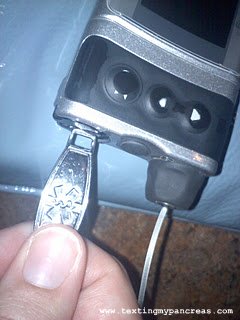
Sometimes you promptly lose the "keys" that come with your pump - the ones required to loosen the cartridge from the pump body when you need to change parts out - and really the job is only suited for a skinny, hard, plastic thing, so you have to improvise.

Welcome to The Pumpered Chef.


Monday, April 7, 2014

The t:slim Air Bubble Dilemma.

Editor's note: as always, nothing on this site should be taken as medical advice. I am sharing some troubleshooting I've done with my insulin pump and if you'd like to recreate anything you see or learn in this post, please know that you are doing so at your own risk. If you're unsure, contact your insulin pump manufacturer to make sure you aren't going to void your insulin pump warranty with whatever you're wanting to try. I cannot be held liable if you accidentally turn your functioning medical device into a really expensive paperweight. 

I've been noticing a pretty consistent bummer of an issue lately when it comes to pumping with the t:slim:

My pump likes to err when it comes to air.


Little buggers!


It seems that air bubbles (which, according to Tandem's safety information, can compromise insulin delivery) like to gather in the connector area where the "pigtail" - at the end of the couple inches of tubing that comes directly out of the cartridge - and the luer lock of my tubing meet. I've also noticed a bunch of tiny air bubbles (a Tandem rep I spoke with referred to them as "champagne bubbles") that accompany the insulin I'm priming through the tubing with each new cartridge change.

Here's a better look at the "connector bubble" I'm talking about:


Yeeeeah, that can't be good.

I'm not alone, either: a Google search for "tslim air bubbles" pulled up around 7.6 million results, many of them discussions between patients and caregivers about what they've tried and how one might "beat" the air bubble quandary. (Some of the threads on TuDiabetes and within the Facebook t:slim group are notable.)

That Google search also led me to a YouTube video from a fellow pumper named Scott who has some fairly unique ideas on how one might combat air bubbles. I've tried a variation of his method a couple of times and while I'm still getting the hang of it, it does seem promising to me so far. Actually, it's kind of brilliant (and more work than it seems like you should have to do, but if it works...). Scott told me he's relatively new to pumping - he started using his first pump, the t:slim, last November after years of MDI - and applied some of the same principles he knew from multiple daily injections to his t:slim cartridge changes. He's also an engineer by trade, so yeah, that probably helps.

I'm going to reiterate that this video isn't medical advice and isn't the official way to fill a cartridge as recommended by Tandem Diabetes (but for what it's worth, everyone I've talked to at Tandem seems to be open to the possibilities of other ways of doing things, as long as they don't harm the pump). If you're going to try this, do so at your own risk. (And thank you again, Scott, for letting me share your video!)


I realize that having to bang the side of an insulin cartridge with a Swiss Army knife (is that what he uses?) isn't an ideal solution, but sometimes you have to improvise. (I actually use the old cartridge as my "hammer" of choice, but you do you.) The two key things here for me are the angle at which you're holding the cartridge when pulling the air bubbles out, and the whole in-out-in thing you're doing with the syringe.

At the same time that I started trying out some of these techniques, I also reached out to Tandem Diabetes (makers of the t:slim) to see what their take is. They said they're aware of the air bubble that tends to appear at the connector - the rep even commented that she sees them too, in her demo pump. We ran through all of the normal troubleshooting bullet points - is the insulin room temperature when you're filling with it, are you keeping the pump pigtail-side up when filling and priming, are you making sure there are no air bubbles in the filled syringe (for the record, I don't think I've ever been able to get every air bubble out of a filled syringe - it's just the nature of the beast - but I am usually able to flick the side of the upside-down syringe enough that they all collect towards the plunger, and I stop just short when filling the cartridge so that these bubbles stay in the syringe) are you making sure the luer lock is tightened all the way, etc.

One idea that a Tandem rep gave me and I've tried with success is: when priming the tubing, don't connect the tubing to the pigtail before the fill starts. The pump requires you to prime a minimum of 10 units each time, so what you can do is prime most of your air bubbles out before you attach the tubing. (The thinking here is that a 3 inch piece of tubing is a lot less space for air bubbles to escape through, than through 20 inches or more.) Once you've hit the 10u mark - or if you're feeling especially dexterous, you can just do this part once you see insulin at the top of the pigtail and all of the bubbles have escaped, and the pump is still priming - attach your tubing and continue to prime.

It seems like some combination of these processes might work best for me, and I plan to keep experimenting. If you're using a t:slim - what have you tried? Are you getting the same air bubbles I am, and if so, what are you doing to avoid them?

Friday, March 28, 2014

Watch Your Step.

I'll now be Googling "steel-toed slippers" to wear around the house and grippy gloves for set changes.


Luckily this happened AFTER I filled the cartridge but that didn't diminish the post-incident mental freakout. (And yes, it landed like this. Inches from my bare foot. AAAAAAH.)

And I apologize for all the dog hair. #CorgiProbs


Monday, March 24, 2014

Spring Cleaning.

There must be something in the air this time of year that compels we People of the Pumps™ to clean, consolidate, and reorganize our stock. The weather warms up, the sun shines, the breeze blows, and logically this leads one to think, "man, wouldn't it feel nice to have all of those infusion sets corralled and cartridge boxes stacked neatly by order of expiration date?". (Consider it FIFO for my diabetes life-o.) This is how I spent part of my Saturday afternoon, and I felt so much better when I was done trimming off box tops and neatly Tetris-ing everything into the available drawer and shelf spaces.

image via Pinterest; sadly with no additional credit
It got me thinking about how the way I pine for pretty ways to organize my diabetes supplies is similar to that of a dreamy Pinterest-board-worthy craft room design.

Do you hear me, Container Store?

I mean, yeah, a scrapbooking cart or something similar could work, but I want colorful, custom-made compartments for all of my diabetes stuff. Trays that perfectly fit Insets (like an egg carton); cups that can house one each of everything I need for each cartridge change-out; a docking station for my pump (and an expandable antennae thing to hold up the tubing while it primes?); a shelf with pop-in custom-sized compartments for my various meters; something like a soda can organizer, but for glucose tab jars or test strip vials. Fabric bins that can house extra cartridges, with a clear viewing window to slip in the cut-out label from the box. Color-coordinating clips or ties that tame all of my charging cords. A dry erase board where I can write down the last day/time of my infusion site or CGM sensor change.

Multiple color and pattern options for each part, if you please. Chevron? Yes. Ombre chevron? Oooooh myyyy.

I want the times I have to attend to my insulin pump to feel less obligatory, medical, and "ugh", and more "ooooh, shiny!", special, and fun. And why shouldn't they?

Tuesday, March 18, 2014

Helpful Little Screens.

I don't know if it's due to the amount of diabetes stuff I've been trying to cram into my brain or what, but recalling something like what my fasting BG was even this morning is sometimes a task. Did I bolus for lunch? When am I going to need to change the cartridge again? What's my carb ratio right now? Is this real life? Are we at Chili's?

The t:slim has some very nice bits of info that I wasn't used to having access to with my Ping, and I've been using them liberally. For example:

Touching the top right corner of my homescreen (where it shows how much
insulin is left in the cartridge) brings you to just about all the information
you'd want to know about what your insulin pump is doing right that minute.

In the History menu you can see a visual breakdown of your insulin
use that day (they call it a "delivery summary"), or an average over the
past 7, 14, or 30 days.

If you can't remember when you did the last cartridge fill (hi, me, I do this
all the time), your pump remembers for you.

Struggling to recall all of the BGs you entered today? Dude's all over it.

Or maybe you want to see everything your pump did today -
Complete History it is.


Tomorrow is my first visit with my endocrinologist after starting on the t:slim - let's see if she's as pleased with the availability of some of my data as I am.

P.S. Things have been kinda quiet over here because I've been having fun posting over here instead.

Friday, March 7, 2014

50% Chance.

I'm finding that the acts of using a USB cord and programming a bolus on a t:slim insulin pumps have a lot in common.


Related Posts Plugin for WordPress, Blogger...


You'd think I'd be able to remember which one is on the left or right as I'm whizzing through the screens to get a bolus going....

You'd think wrong.

(Possibly helpful suggestions: make it alphabetical, so BG comes before Carb? Or just use icons like a blood drop and an apple, for example, instead of words?)

Wednesday, February 5, 2014

"We Are Not Waiting": The Tidepool/Asante Partnership.

Last week it was announced that Asante, makers of the Snap insulin pump, are the first diabetes device company to partner with Tidepool, a non-profit working to reduce the burden of T1D, in an effort to make diabetes device data open and available to patients and their caregivers.

This is where I'm going to highly encourage you to check out what Tidepool is doing, because it helps explain why this partnership with Asante is such a big, big deal.

I wanted to learn more about what exactly this partnership means, so I reached out to Asante and was able to chat with their CEO, David Thrower, and then with the CEO of Tidepool, Howard Look. They were kind enough to talk me through some of their vision for what this partnership could mean, and how it might improve the lives of PWDs.

What I learned is: yes, this is HUGE.

Wait, nope, hang on. More emphasis required.

THIS IS HUGE.

For example: you know how if you wear one brand's pump but want to use another brand's CGM, you're stuck using two different proprietary software programs to upload and interpret your data - and maybe you can't even access all of the data you want? Same goes for a glucose meter that works independently of your insulin pump or your CGM. They're all stand-alone devices, and most of them don't talk to each other. You're often forced to choose between using devices that the manufacturer has decided to integrate (a Medtronic pump and CGM, or an Animas Ping and their meter-remote, for example), or using the devices that you like best.

What if you were no longer bound by proprietary nonsense, and could choose devices based on what works best for you without being bound by what device-makers decide would work together? What if you could upload everything to one platform, and that platform could tell you everything about what your devices are capturing and recording - and help you decide what to do next?

What if that platform enabled you to use any number of apps, all of which were pulling data from all of your devices?

What if you could log into the cloud and see your child's CGM graph, in real time - while they're away from home?

A demo screenshot of what Tidepool's platform might let one see, moving in real time


What if you could send that CGM graph to another device? What if the graph you could see belonged to your child; your spouse; your patient?


What if your data was yours, and you got to choose how to look at it and what to do with it?

A screenshot from Tidepool's first app, "blip".


That's exactly what Tidepool is working to make a reality, and Asante has made a bold step in being the first device company to say, "yeah, we believe in this vision of open device data, too". As Tidepool's Look put it, "It's very apparent that there's a need for open data that PWDs and their caregivers can access in whatever way they want". Asante's Thrower echoed: "We founded Asante with the notion that diabetes comes with a constant and high cognitive load, and whatever we can do on our side to reduce that burden - to simplify the monitoring and treating of diabetes - that's what we ought to do".

And also from Thrower (I'm paraphrasing here): "In all of our strategies, let's treat people like people - not just consumers attached to a medical device. Their device choices should be based on what works best for them, not what works with what you already have. A logical extension of this is to make available to people whatever data is useful or that can inform their management decisions." And not in an endless, unintelligible spreadsheet, either - they want to present that data in a way that people can understand and use.

Can I get an amen!


So all of this sounds great, but isn't FDA going to need to approve this? (And the cynics in us lament, and how long will that take?)

Yes, they will. And here's what they had to say: the key is engage early and often, and Tidepool has already met several times with FDA. Tidepool aims to classify their platform as a "masterfile" with FDA, and any corresponding applications may or may not need subsequent FDA approval.

So what can we, as a community, do to help make sure this vision of open and accessible data becomes reality? Here is Tidepool's ask:

  • If folks would like to stay in touch with updates, they can add themselves to our mailing list at tidepool.org and also follow us at @Tidepool_org and Facebook.com/TidepoolOrg .
  • We are about to start a pilot study of blip at UCSF. If folks are patients at UCSF, they should talk to their doctors there.
  • Open source developers should send us a note, info@tidepool.org. Soon we’ll have lots of ways they can contribute. They can also find our code repositories at GitHub.com/Tidepool-org, and our nascent developer portal at http://tidepool-org.github.io. We’d also love help from QA people, test developers, and documentation tech writers.
  • Of course, as a non-profit, we warmly welcome donations to our efforts at tidepool.org/donate.

And here's where the business major in me raises its voice: I hope the market rewards companies like Asante for making bold steps like this. If this is truly the kind of revolution we want for ourselves, we have to raises our voices.

(And remember - Asante is still offering those four-week free trials with their insulin pump.)

Editor's Note: Neither Asante nor Tidepool solicited me to write about this. When I saw the news break last week I was surprised to not see more enthusiasm and excitement, so I'm assuming most people just didn't realize what had happened. This is my own effort to help spread the word.

Tuesday, February 4, 2014

Diabetes Lifehacks.

One of the benefits of the DOC (diabetes online community) is that we get to share the tips and tricks that only a person really living with it would know, in an effort to make our diabetes management a little bit easier. It's group problem-solving at its finest: crowdsourced answers to common challenges.

To use another buzzword, a lifehack can be defined as an "uncommon solution to common problems", or "unusual ways of using everyday objects to make life easier".

Since Googling "diabetes lifehacks" didn't bring up much for me in the way of search results (although I did find this thread on TuDiabetes), I'm going to do what I can to fix that problem with this post.

(Important note: nothing here can be considered medical advice, and if you're unsure about something, check with your doctor first. Let's approach this as, "this is what I do" and not "this is what you should do". If you're sharing someone else's tip(s), please credit them!)


Here are some of the ones I'm aware of (and yeah, a lot of them are CGM and insulin pump-centric).

Wondering how to get Dexcom sensors to last longer? This is at least a two-part answer. The first part is getting the receiver to take readings again: you can either find "stop sensor" in your menu, or wait until the receiver tells you that the 7-day period has expired (and it stops taking readings on its own). After that sensor has "stopped", go back to your menu and select "start stensor". After another two-hour period, you can calibrate (by entering two fingerstick results) and continue on, with the receiver believing you're using a fresh sensor, when it really is the one you were already wearing.

The second part has to do with the actual adhesive - it's likely not going to stay stuck to you for a full seven days on its own. Use a medical tape like Opsite Flexifix (a DOC favorite), IV3000, or Tegaderm. Find tips here, here and here on how others use this tape.

If you have trouble remembering how long you've had your Dexcom sensor on, or when the 7-day expiration will happen, write the date and time of your sensor insertion on the sensor's packaging and hang onto it (this way you keep the sensor's serial number on hand too, in case you'd need it for calling Dexcom about sensor issues), or take a picture of it with your iPhone or similar device (the date you took the photo will be saved that way).


If you're pumping with a t:slim and wrestle with keeping tubing and the pump upright during a prime sequence, kitchen cabinet knobs are your friend.

Changing the battery out of an Animas Ping insulin pump without using a coin can still happen if you're wearing a medical ID bracelet.


If you need to disguise an insulin pump/CGM receiver/tube of glucose tabs under a dress, try making your own garter using thigh-high hose, sew a pocket into the dress, or maybe sport some stretchy shorts underneath. In a pinch? Baby sock + safety pin = you can wear your pump just about anywhere on your person.

Can't hear your Dexcom alarms while you're sleeping? The ol' glass and coins trick may work.

Remembering to grab all of the right insulin pump cartridge/site change-out parts become easier when you use small Ziploc bags for the parts. Especially helpful if you'll need to do a change-out away from home and tend to forget parts (cough, me, all the time) - just grab one baggie and one vial of insulin and you'll be good to go.


If you're on MDI (multiple daily injections) and don't want to mix up insulins whose packaging may be similar, use something like colored duct or washi tape around the outside of the vial (or pen!) to distinguish them. (You can also use washi tape to dress up a glucose meter!)

(Speaking of true hacking... check out this Dexcom DIY set-up for monitoring someone in another room. Whoa.)

Need a small sharps container while you're traveling? An empty glucose tab jar or eye makeup remover wipes container packs nicely.


Empty test strip tubes are also a good place to stash the used test strips in your meter kit - use a sticker on the lid (or marker on the labeling) to tell them apart.

Infusion sites can be dressed up with the help of a little nail polish and creativity:

Images courtesy of Amy Dooley; D-Momma to Lauren


What are your favorite diabetes lifehacks? Please share them in the comments section!

Monday, January 27, 2014

Review: Tandem t:slim Insulin Pump.

I wanted to give myself a few weeks of living with it before I shared my thoughts on the t:slim insulin pump I'm now wearing. I've had time to do several cartridge changes, program boluses of all flavors, experience some alarms and alerts, download my data a few times, and basically just see how this tech fits into my activities (and outfits).

You may not have the patience to read everything I'm going to write about this pump (I get that; do your thing), so here's the GIF short-hand. It's going to be about 90% this:


And the remaining 10% somewhere around this:


My insulin pump experience includes four years with a Cozmo, and four years with an Animas Ping, plus a few weeks of trying out the Snap, so keep that in mind as my frame(s) of reference.

I realize no insulin pump is "perfect" and probably none will possess all of the things I like (and none of the things I don't), but the t:slim gets preeeeeetty close, for me.

Let's get the less favorable qualities out of the way first:
Nothing to see here; everything's normal

  • While it's advertised as a pump that can hold 300 units, I don't see a way to actually get to use all 300. When I tried to fill the t:slim's cartridge with a full 300 units (it may have been more like 302), it caused an error that rendered the cartridge - and its insulin - unusable. I called customer service when the error came up, and they said that particular message code appears when the cartridge has been overfilled, and that I wouldn't be able to use that cartridge. Whoops! (Sidenote: some suggested I could draw the insulin back out using the syringe I filled it with, but I hesitated to do so. I'd rather play it safe than use possibly contaminated insulin; that's just me though.) The t:slim still holds more than my Ping did, though, so I can live with it.
  • The tubing prime when starting a new cartridge - OH MY does this process seem ridiculous. Having grown used to the < 30 seconds a prime took with the Ping, and the .5 seconds it took to prime tubing with the Snap - this step feels painful. And not only does it take a long time - think minutes, not seconds - I was instructed to sit not only the pump, but the tubing upright during the prime to avoid air bubbles. Considering I use 43" tubing - it's a sight to behold, and a task I've assigned to my kitchen cabinet knobs. (See right.) 
  • When my t:slim was shipped to me, they asked what kind of infusion sets I wanted and we decided I'd try some Cleo sets. Unfortunately I had quite a few issues with using these - I've sent back the unopened boxes to swap back for Insets - among them, an airbubble that would get stuck where the "pigtail" meets the luer lock of the tubing. However when I switched back to Insets, I couldn't see that bubble anymore, so this may be a non-issue for me going forward.
  • There are what seem to me to be an exorbitant plethora (I like big words as much as I like GIFs, okay) of confirmation screens. I'm aware that this was due to FDA's concerns about a touch screen on a medical device (think about how many people butt-dial on their phones; now imagine butt-bolusing), but it's still a concern from a usability standpoint. It annoys me.
  • The "manual bolus" option - that is to say, a way of telling my pump to just administer a certain amount of insulin, not associating it with carbs or a BG - is non-existent on this pump. While there is a workaround that involves programming 1g of carb, and then overriding the units of insulin from there - it seems a silly thing to have omitted.
  • The lowest profile clip they offer, which is also the clip that now comes with the pump when you order it (the "t:clip"), is not as low-profile as I'd prefer. Again, I'm used to Animas' clip, which was so nice! And when clipped to the top of my pants, more of the Animas pump would be "below the line", so to speak, than the t:slim and its case.
  • And finally, the way it delivers insulin - with this "bladder" that I'm not able to see, within the cartridge - is something new to me. I'm going to need some time and an accumulation of good experiences before I can develop full trust in how reliable and accurate this is. 

There are a few other small things, but they may just be things I need time to get used to, rather than downsides of the pump itself. It's also worth mentioning that during my first few days with the t:slim, my blood sugars were running higher than I expected them to. But, once I switched back to Inset infusion sets from the Cleos, things seemed to even out for me. It could be coincidence and due to some other factor, but it happened, so it's worth noting.

Onward.

Here are my "Oh, HELL Yeah!" items:

  • It feels, looks, and behaves like an insulin pump in 2014 should. How I feel about the way I manage my diabetes plays an important role in my psychosocial health, for better or worse, and things like a touchscreen (no more scrolling - huzzah!) and data displayed in color (with graphics!) please my sensibilities. The screen is bright; the vibrate setting is noticeable but not too vibratey (technical term); the pump's "feel" is solid and sleek. This matters to me.
  • It has a vibrate option, instead of all audible alerts and alarms.
  • There's a touch bolus button, which allows me to program a bolus without ever needing to look at my pump screen - I use this often, and realized after trialing the Snap pump that this was a must-have for me.
  • The "basics" are all on my home screen, or just one tap away: things like my insulin on board (IOB) and time of my last bolus, current basal rate, battery life, insulin left in cartridge and current I:C ratio are all easy and quick to access. 
  • I can plug the pump into the wall, or the USB port on my laptop, or my car,  to charge it. That is so boss.
  • "Personal Profiles" include everything you might want to reset for that time of day - not just basal rates, but also I:C, correction factors, target BG, and more can be tailored in each individual profile.
  • Speaking of personal profiles, you can name the profiles whatever you want. Again, seems small - but being able to have a profile named "Eff Yeah Wknd" makes me smile.
  • I considered listing this as a negative, but I'm actually thinking it should be a plus: the t:slim seems more occlusion-sensitive than other pumps I've worn. This could be good as long as the alarms are actually truthful. 
  • It's water-tight. Excellent.
  • Delivery noises seem much quieter to me. I'm not talking about confirmation beeps, but the actual noise the piston makes when delivering a bolus or basal. Anyone who has used an Animas Ping and spent any amount of time in a library or super-quiet work environment (hey, that's me!) can attest to the loud noises it makes while delivering insulin, and that always bugged me. Sweet relief!
  • I hadn't realized this ahead of time, but the t:slim will alert you if you it thinks a bolus you're creating will cause you to go low. I love a device that can help me out like that.
  • The t:connect software (Mac-friendly - yay!) is very visual and easy to use, and I like not having to mess with a special cable/dongle in order to access my information. Downloading my Ping was always such a clunky process that it deterred me from doing it very often - t:slim is very plug-and-play with any micro-USB cord. My doctor hasn't tried to access my data yet (I've heard there's no provider version; that they'll need my password to access it, which doesn't seem right), but so far I like it for my own use.
  • I've found Tandem's team to be very responsive - customer service has been good, and my local reps have been very accessible, through emails, texts, calls, or whatever medium I might want to use. And when they issued two different voluntary recalls on cartridges - mine were affected - I was alerted by tweets, phone calls, emails, AND snail mail. 
  • Back to those t:clip cases - again, a small thing, but you can totally mix and match colors on these, because the clip is two parts. 
  • One last thing - I'm looking forward to hearing more about the partnership Tandem and Dexcom have forged in order to get an integrated system to market. 

I'd also be interested in hearing what other t:slim users do or don't like about pumping with this particular device, so feel free to comment all over this.

As I said, I'm only three weeks in. Time will tell if this pump is a good fit for me over the long haul, but so far? Thumbs most of the way up.


Monday, January 6, 2014

Aaaaand, We're Live.


Related Posts Plugin for WordPress, Blogger...

T:slim training complete; hooked up and ready to party.


Friday, January 3, 2014

Review: Asante's Snap Insulin Pump.

Disclosure: This review was written by me, and was not edited or approved by Asante. I was not monetarily compensated for this review, and opinions are, as always, my own. Also, I must be on a Kristin Wiig kick because I feel a little like Aunt Linda with all of these 'review' posts. "I give it four 'BEEP BOOP BEEP!s!' and an 'Oh, Brother'!")

In my recent search for a new insulin pump, I was able to try out Asante's Snap for a few weeks. (They offer a free trial to those who qualify.) I mentioned this in an earlier blog post, pointing out some "first impressions".

I know the screen looks hard-to-read here - rest assured, this is the
"dim" screen, right before it falls asleep. The screen is much brighter
while you're interacting with it.

Now that I've had a good amount of time to educate myself on how it works, and specifically how it would work for me, I'd like to share a few thoughts.

So, if you don't mind dedicating 14 minutes of your life to watching me talk, here's my review:


(And if you don't want to/can't watch the video, here's the take-away: I really loved wearing it and how the Snap functions, but it's missing a few items on my "Top Ten" of insulin pump features, so in the end I didn't choose to buy it. It's a great pump that I would recommend to others, and who knows - maybe future iterations can include the features I missed.*)

I also did a shorter video showing just how the super easy cartridge change-outs works, since that's one of the main features Asante likes to point out about the Snap. I found it to be as simple as they make it seem.


If you'd like to try out the Snap too, contact Asante and see what's up.

Now for a few days without blogging. Vlasnik OUT!

*Two things: the bit about not having a touch bolus option? I was uninformed! The Snap can do that; I just didn't have my demo pump programmed to do it. And second: the "no software" problem has now been resolved; Snap is compatible with Diasend software. Huzzah!


Tuesday, December 31, 2013

Choosing An Insulin Pump: The Jedi Returns.

Guess what finally happened yesterday?


I think the image I linked to it that tweet got lost, so here's a similar one for reference:

SO FREAKIN' EXCITED


I had been pestering calling the CareCentrix (my DME provider; henceforth abbreviated as "CCX") rep just about every day since my case was reopened, and yesterday she finally got to call me with the good news that my request for a new insulin pump was approved. It was a bumpy and anxiety-ridden ride for me that was full of tweets, emails, and phone calls. In short: I had to be loud, persistent, and relentless, as well as my endocrinologist providing additional information of many different varieties.


To Cigna and/or CCX's credit, they did (for the most part) do a good job of keeping in contact with me. Most emails to Cigna customer service were responded to the same day, and the rep from CCX also gave me her direct extension so that I could call her any time I had a question or concern, which I did quite often. (By the end of it, I had her extension memorized!)


According to CCX, it was my endo's office that contributed to a lot of the delay. I don't know whether that's true or not, but with all of the requests CCX made of my endo's staff (fax records, answer these questions, now fax other records, now we need a letter from you explaining why she needs this, now we need to know what's wrong with her pump AGAIN....) and a short-staffed office that is no doubt bombarded at this time of year with last-minute requests, I can understand why it would take some time. Still, I was filled to the brim with anxiety and frustration.


And then, a breakthrough!


But who knows how long their "review" would take, and I could just imagine that it would conveniently require time into the New Year to complete, which is when our deductibles would reset (and I would be responsible for the balance of the cost insurance wouldn't cover).

This is when I may have gotten a little sassy, but you know what? That gets stuff done.


Shortly after I tweeted that, the nurse at my endo's office called. "Your insurance just called, and asked about your pump. So tell me again what's mechanically wrong with it?" I repeated myself for what seemed like the tenth time: the housing is scratched, and the buttons are not as responsive as they should be. "I'll press a button, but it doesn't always recognize that I did, the first time. I have to press it a second time for it to register."

"Ah, okay. Perfect. I'll call her right back. Thanks!"

And a couple of hours later, I got a call from CareCentrix. It was the nurse who had been reviewing the "audit" (I shouldn't call it an "appeal", but "audit" is okay? Whatever you want to call it is fine, just approve the darn thing), and I have to believe this is her favorite kind of phone call to make.

"Hi, Kim? I'm an RN with CareCentrix and have been the one reviewing your file - I spoke with a nurse at Dr. [name redacted]'s office this afternoon, and she was able to provide the last of the information we needed while completing your audit. I wanted to verbally let you know that your request for an insulin pump has been approved."

I made a noise that can't really be recreated, except by the combination of relief, exhilarating joy, and delicious victory.


Being that it was the second-to-last day of the month, my next question was, "So what is my next step to moving this along? Do I contact the pump company?" "I will fax over the authorization documents in the next few minutes here, so they actually haven't received them yet - give me 10 minutes or so, but yes, if you have a direct contact with them, you could call and tell them to look out for my fax." Whoopee!

No sooner had I hung up with the CCX nurse than I was on the phone again, asking if an authorization had been received yet. It hadn't, and the pump rep and I have been in contact back-and-forth since then, getting everything in place. There's still some panic in my system as this is really down to the last possible moments, but she assured me that she would "get this to you even if I have to drive it to you myself". Ha!

So, by now you may be wondering which pump I ended up going with - since the order hasn't technically been placed yet, I'm not real comfortable disclosing that at this time. It doesn't feel real yet! But once the order has been placed, I'll let you guys know.

For now, I'll be relishing in the feeling of finally having "won" the right to own one of the medical devices that helps me stay healthy.

Huzzah!!

UPDATE: The pump is now ordered, so I can feel okay telling you: I ordered a t:slim. If you're  wondering why I ended up going with it over staying with Animas or switching to the Snap... 

I'll explain my thoughts on Snap later this week(tl;dr: I love it, but it's missing a couple of features that are super important to me, personally), but it comes down to t:slim having the features most important to me, that the other two pumps just don't offer at this time. I think the Ping is a great pump, and doing the trial with a Snap pump was a pleasant experience, but for what I need right now t:slim seems to be the best fit. More on that later.


Monday, December 9, 2013

Choosing An Insulin Pump: The Empire Strikes Back.

[An update/resolution to this post can be found here.]


"I have heard there are troubles of more than one kind
Some come from ahead, some come from behind
But I've bought a big bat, and I'm all ready, you see
Now my troubles are going to have troubles with me"

- Dr. Suess


It hadn't really occurred to me that obtaining a new insulin pump to replace my soon-to-be-out-of-warranty one would be a challenge. Based on my past experience, I figured that filling out all of the paperwork would be the most difficult part of the process (and God laughed): the warranty on my Animas Ping expires at the end of this month, so of course I need a new one. The pump's housing is quite scratched up, and the buttons are not as responsive as they once were. The pump's technology is now at the very least five years old (FDA approved the Ping system for sale in July of 2008), and doesn't have many of the features that newer pumps offer patients.

Except that Cigna and Care Centrix (my insurance and DME providers) don't seem to agree.

For a company that says they are "dedicated to helping people improve their health, well-being and sense of security", I'm sure not seeing it. Using a medical device that's endured four years of use and (inadvertent) abuse is going to help my "sense of security"? Do you know how many times this pump has been dropped, knocked around, or been exposed to snow and below-freezing temperatures? It's the nature of wearing a medical device 24/7 for four years. It's normal wear-and-tear.

This process started with me filling out patient info forms with both Tandem and Asante (figuring that since Animas was already approved for me, I didn't need to pursue that route), and my doctor faxing over the needed signatures and documents. It's been a few weeks since we did that, and an insurance verification rep from Tandem and I have been emailing back and forth periodically throughout the process (asking when my current pump was purchased, if it was still in warranty, etc.). When I answered that my pump was purchased in December of 2009, the rep responded positively. "Great news", she said.

And I thought it was, too.

Except that her follow-up email said this:
"Just got off the phone with CareCentrix. Per CCX the expiration date does not warrant a new pump. They state the current pump most be malfunctioning or not meeting your medical needs."
I  responded by telling her about the pump being scratched up, and the buttons not working consistently.
"The only way we can get this approved is if we could show your A1C’s being effected by the current pumps malfunctions. Looks like your last A1C’s were in the 6’s which would be considered manageable. We may have to wait until the warranty is up on the pump and the functionality is no longer meeting your medical needs."
Expressing my disappointment, I told the Tandem rep that I'd be contacting Cigna. She added that she was very surprised to find out that Cigna does not have an automatic approval policy for a new pump when the old one is out of warranty - to her knowledge, they are the only carrier with that policy.

I also want to point out that the Cigna employee used the phrase "entitled to" when referencing my ability to obtain a medical device that makes a huge difference in how I am able to manage my health.

I took to Twitter.


And then, a ray of sunshine:


You bet I'll email you. R2? Fire up the converters!


Because the thing is - it's great that I have an insulin pump already, and I'm thankful for it. It is one tool among many that has helped me attain what is apparently the only criteria that Cigna cares about - a "good" A1C result.

What Cigna fails to factor into their judgement here is that A1C isn't actually a great summarization of my diabetes management - it simply provides an average. It doesn't factor in standard deviation of glucose values, it doesn't predict the chances of me developing complications, and it certainly doesn't relieve any of the cognitive burden of managing this disease all day, every day. My A1C doesn't tell them how I attained that result.

And what Cigna/CareCentrix also fails to recognize is that part of the reason I'm okay NOW is that I have been able to use the best of what's available NOW. If you want me to continue to be healthy in the future, I need to be able to use the best of what's available in that future. "You're doing okay with what you're using" is the exact argument FOR a new device being approved. Let's make sure I keep doing okay.

What this boils down to is really simple - Cigna/CareCentrix can either pay for a new insulin pump now (because that is the treatment option that is most effective for me, given what's currently available), or they can wait until I've experienced any number of adverse health outcomes that result when this old insulin pump malfunctions and pay for any resulting hospital charges. Show me where that fits into their mission statement of "helping people improve their health and well-being".

Do I sound dramatic? Good. This is my life and my health we're talking about, and I take that health very seriously. Give me the tools I need to help me be healthy, and it will save you money in the long run, Cigna. If the technology is there, let me use it.

Let all of us use it. This isn't just about one person with some degree of social media influence fighting for what she needs - this is about every person having access to what can help them achieve good health. This is about all of us, and moral issues aside,  it's to a payer's financial benefit that their customers have access to the baseline preventative care they need.

I will write whatever needs to be written; show whatever needs to be shown; speak with whomever needs to be spoken with; do whatever needs to be done. Their policy is wrong, and I'll be happy to tell them exactly why.

(Where things stand as of this posting: Cigna has spoken with CCX and the request is being looked at again. I'm working with my endo's office to get CCX whatever proof they need to get a new pump authorized and covered.)

"Sir, the possibility of successfully navigating an asteroid field is approximately 3,720 to 1." - C-3PO
"Never tell me the odds." - Han Solo