Showing posts with label CGM. Show all posts

Tuesday, July 29, 2014

So It Goes.

A reenactment:


Saturday morning, fasting:

CGM: HIGH

::mumbles profanities under breath; pulls out meter::

Meter: 528

::boluses::


Sunday morning, fasting:

CGM: 285

::grumbles; pulls out meter::

Meter: 265

::boluses::


Monday morning, fasting:

CGM: 312

::profanities again; pulls out meter::

Meter: 249

::boluses::


Tuesday morning, fasting:

CGM: 332

::dramatic groan; boluses off of CGM reading because this is now four mornings in a row; then pulls out meter::

Meter: 175

Dramatically looks at ceiling as she contains her rage


Wednesday, July 9, 2014

Suddenly, Bloggers.

The diabetes community is to hotel bars as Corgis are to the internet?


It may be a while before my brain unscrambles enough to write about FFL, so you'll have to put up with me posting the three photos I took at the conference in the meantime.

Tuesday, June 17, 2014

A Bad Habit.

When my endocrinologist downloads the data from my Dexcom receiver later today during my appointment, she's bound to notice quite a few gaps - like the one last night, where there will be no data from around 11:30 pm until I woke up this morning at 5:45 am.


You see, about a half hour before that I had clocked in at 80 mg/dL. I had no insulin on board and no food in my stomach, as dinner was hours before that. I hadn't gotten much exercise that day or the day before, so I felt reasonably comfortable taking the gamble of doing nothing about a reading that teetered right on the cusp of being "low".


Literally the only things I did in the next few minutes were brush my teeth, plug in my phone, and lay down. I tossed and turned though, and couldn't find a comfy position. And when I finally did?

BZZZ! BZZZ! BZZZ!

Where the hell did that 67 come from? And then the 55? Mild sleepiness transitions to anger: Ugh, GOD, I'm fine, stop freaking out.

Again: BZZZ BZZZ BZZZ BZZZ!

That's it; I'm done. You're done. 

Some might say, "TURN DOWN FOR WHAT". Lately, I too often say, "SHUTDOWN FOR SLEEP".


#AllTheSocialMediaChannels

It worked out in this instance, but there's never any guarantee - when I turn off my CGM receiver, I'm opting out of a safety net. In theory this shouldn't bother me, as I should be able to use technology in the ways it works for me (and opt out of it when it doesn't), but that all too often comes with a side order of guilt. When I'm forced to decide, "what's more important - sleep or safety?", all too often the need to sleep has been winning.


Wednesday, June 4, 2014

How Will I Know?

How will I know if this sensor loves me?
I say a prayer with every reading
I watch the graph whenever I eat
I'm asking you why I can't just believe this thing

This sensor's new
Why do I feel weak?
How will I know?


Related Posts Plugin for WordPress, Blogger...


(Thoughts on some graphs that feel too good to be true lately. Why isn't my gut reaction to be happy for these results, instead of being skeptical of their accuracy?)

Friday, April 25, 2014

"Good" Morning.

I wake up and am all, yeah! Let's start the day! Watch out world!

And then I look at my CGM graph.


::shakes fist at the heavens::


Wednesday, April 16, 2014

Anatomy of a Dexcom Graph.

Related Posts Plugin for WordPress, Blogger...


At first glance this graph looks... not fun, but something along the lines of "you were running high, did a correction bolus, and then you were low".

But looking at it another way, it's:

1. "Why is this high so sticky? I under-bolused for that sandwich at lunch because I could see I was dropping and knew I'd be home alone with my daughter for the next few hours, but apparently I overdid it. UGH. This feels so gross, and it's almost dinner time. Since all of those corrections over the past few hours didn't do much, I'm finding out what my pump would suggest for a correction bolus if I had no IOB and bolusing that amount."

2. "Yaaaaasss. Now stick the landing, you glucosey blood you."

3. "No no no noooooo [insert curse words here] do not want, stop it. Just level off! Stop dropping! You're good! Just stay right here!"

4. {inhales Peeps; notices legs are tingly/numb; delegates remainder of dinner assembly to husband; sits at dinner table waiting to regain self}

I find myself doing this thing where I underbolus for food or just run a little higher in general when I'm with my kid because I don't want to drop low while I'm the only one responsible for her, but I usually end up rage-bolusing my way out of it and end up low anyway, the very outcome I was trying to avoid in the first place.

Wow, so doge meme, how obsess, much annoy husband, very giggle!


Thursday, February 20, 2014

Swoosh.

You know what I would love?

I would love it if the pattern-alerting capabilities of my glucose meter could be magically infused into my CGM.


Being alerted to patterns is cool and all, but it only really works if it's coming from a device that is taking enough readings for those patterns to be meaningful. (Related: I've been using the VerioSync meter for... two and a half months now?... and in all that time, it's alerted me to one pattern. ONE.) My BG testing has deteriorated to just a few times a day lately, with the rest of my guidance coming from my Dexcom's display. (I'm going through a bit of "eff this noise" burnout, but I can see that there's a well-lit end to this tunnel and I'm inching towards it.)

And because noticing patterns isn't one of my strong suits, it's taken me several days - not all in a row, but enough of them sprinkled over the past few weeks - to catch onto the fact that when I'm waking up to something over 200 and program the suggested correction bolus, I'm crashing an hour later - usually right as I arrive at work. Which means I kick off my work day in a sweaty, shaky, impatient, and slightly confused sort of way. "Awesome".

Even when I'm not issuing a correction bolus, I still see my graph trend down by 25 points or so in the first hour after waking - which would be fine if I woke up at 125, but when I wake up at 80 it's a real problem. My meter doesn't catch any of this if I'm not testing during this period of time.

While I'm thankful for the devices I have access to right now, I can't help but feel that they're:


Tuesday, February 18, 2014

Advocacy Help Needed: CGMs and Medicare.

Did you know that Medicare won't cover continuous glucose monitors (CGMs)?

It doesn't matter if you have hypoglycemic unawareness. It doesn't matter that you may have proven in the past that using a CGM lowers your A1C, or helps you avoid dangerous low bloodsugars, or saves your insurance carrier thousands of dollars in hospital bills when all hell breaks loose. It doesn't matter if your physician write a compelling letter stating its medical necessity.

Medicare will not cover CGM devices, for any reason, period. If you want one, you're paying out-of-pocket.

Sitting here as a thirty-something, it would be easy to dismiss this as something that doesn't apply to me. But if I'm lucky (or, depending on how you're looking at it, maybe it's the opposite?), someday this will absolutely apply to me, and I find it hard to sit on my hands and do nothing when I know that others need help. I value my CGM very much, and imagining my life without that technology available to me is a scary place to go.

I received an email from Laddie and Sue over at Test, Guess, and Go about Sue and her husband's struggle to get a CGM, and Sue is asking for the DOC's help. From Sue:
My husband has Type 1 diabetes with severe hypoglycemia unawareness and was previously covered for his Continuous Glucose Monitor (CGM) by private insurance. Unfortunately, when he went into the Medicare system at age 65 and needed a new CGM, it was denied because Medicare considers it a “precautionary” device. We appealed Medicare’s decision and quickly moved through the first two levels. We are now in Level 3 and had a hearing with an Administrative Law Judge on June 26, 2013. 8 months later we are still waiting for the Judge’s decision.

In the meantime, my husband has been without a CGM for over a year. During this time, he's had some pretty close calls. It's only through luck...or God watching over him...that he hasn't harmed himself or someone else.

Because of the incredible frustration and exhausting fear that we have experienced, I have become an advocate for all people with diabetes who need a CGM or will need a CGM in the future. Representative Carol Shea-Porter [D-NH1] has taken up the cause and introduced a bill into Congress: H.R. 3710: Medicare CGM Coverage Act. This bill provides for coverage of CGMS by Medicare if recommended by a physician. I have been in touch with Shea-Porter's Legal Assistant, Marjory Connolly, and they are currently doing a big push among Shea-Porter’s colleagues in the U.S. House of Representatives asking them to sign onto this bill.
You can find more about Sue's story, and what YOU can do to help, here: http://testguessandgo.com/2014/02/17/join-the-crusade/  Sue has thoughtfully laid out exactly what you can do, and has even provided a template for you to use when you contact your Representative. For those who haven't called a member of Congress before, I promise you that speaking with them is not as intimidating as you may imagine. Do your research so that you know what you want to say, and call. Be confident in your own voice. It's their job to listen.

Nothing will change if we do not speak up.


Monday, February 17, 2014

Dexcom Handle.

Related Posts Plugin for WordPress, Blogger...One disadvantage of sporting an arm site for my Dexcom sensor:


They're within reach of tiny hands and tend to be grabbed onto any time a "handle" is needed. (And those tiny hands tend to release their grip seconds before you're able to snap a photo, but I trust you can use your imagination.)


Tuesday, February 4, 2014

Diabetes Lifehacks.

One of the benefits of the DOC (diabetes online community) is that we get to share the tips and tricks that only a person really living with it would know, in an effort to make our diabetes management a little bit easier. It's group problem-solving at its finest: crowdsourced answers to common challenges.

To use another buzzword, a lifehack can be defined as an "uncommon solution to common problems", or "unusual ways of using everyday objects to make life easier".

Since Googling "diabetes lifehacks" didn't bring up much for me in the way of search results (although I did find this thread on TuDiabetes), I'm going to do what I can to fix that problem with this post.

(Important note: nothing here can be considered medical advice, and if you're unsure about something, check with your doctor first. Let's approach this as, "this is what I do" and not "this is what you should do". If you're sharing someone else's tip(s), please credit them!)


Here are some of the ones I'm aware of (and yeah, a lot of them are CGM and insulin pump-centric).

Wondering how to get Dexcom sensors to last longer? This is at least a two-part answer. The first part is getting the receiver to take readings again: you can either find "stop sensor" in your menu, or wait until the receiver tells you that the 7-day period has expired (and it stops taking readings on its own). After that sensor has "stopped", go back to your menu and select "start stensor". After another two-hour period, you can calibrate (by entering two fingerstick results) and continue on, with the receiver believing you're using a fresh sensor, when it really is the one you were already wearing.

The second part has to do with the actual adhesive - it's likely not going to stay stuck to you for a full seven days on its own. Use a medical tape like Opsite Flexifix (a DOC favorite), IV3000, or Tegaderm. Find tips here, here and here on how others use this tape.

If you have trouble remembering how long you've had your Dexcom sensor on, or when the 7-day expiration will happen, write the date and time of your sensor insertion on the sensor's packaging and hang onto it (this way you keep the sensor's serial number on hand too, in case you'd need it for calling Dexcom about sensor issues), or take a picture of it with your iPhone or similar device (the date you took the photo will be saved that way).


If you're pumping with a t:slim and wrestle with keeping tubing and the pump upright during a prime sequence, kitchen cabinet knobs are your friend.

Changing the battery out of an Animas Ping insulin pump without using a coin can still happen if you're wearing a medical ID bracelet.


If you need to disguise an insulin pump/CGM receiver/tube of glucose tabs under a dress, try making your own garter using thigh-high hose, sew a pocket into the dress, or maybe sport some stretchy shorts underneath. In a pinch? Baby sock + safety pin = you can wear your pump just about anywhere on your person.

Can't hear your Dexcom alarms while you're sleeping? The ol' glass and coins trick may work.

Remembering to grab all of the right insulin pump cartridge/site change-out parts become easier when you use small Ziploc bags for the parts. Especially helpful if you'll need to do a change-out away from home and tend to forget parts (cough, me, all the time) - just grab one baggie and one vial of insulin and you'll be good to go.


If you're on MDI (multiple daily injections) and don't want to mix up insulins whose packaging may be similar, use something like colored duct or washi tape around the outside of the vial (or pen!) to distinguish them. (You can also use washi tape to dress up a glucose meter!)

(Speaking of true hacking... check out this Dexcom DIY set-up for monitoring someone in another room. Whoa.)

Need a small sharps container while you're traveling? An empty glucose tab jar or eye makeup remover wipes container packs nicely.


Empty test strip tubes are also a good place to stash the used test strips in your meter kit - use a sticker on the lid (or marker on the labeling) to tell them apart.

Infusion sites can be dressed up with the help of a little nail polish and creativity:

Images courtesy of Amy Dooley; D-Momma to Lauren


What are your favorite diabetes lifehacks? Please share them in the comments section!

Wednesday, January 22, 2014

Self-tracking and Diabetes.

There's this idea of a "quantified self" - that the better we can track, measure, analyze, and interpet our own personal health data, the better we'll understand ourselves. I heard a whole bunch about it at the first Medicine X conference; it seemed everyone was enamored with the potential of self-tracking tools: blood pressure, sleep patterns, heart rate, you name it. And for people living with diabetes? Whoa-ho! We're the original self-trackers; so open to wearing gadgets both on and underneath our skin, accustomed to the charts and graphs and incessant flow of data. Tiny computer directly on your eyeball? Of course they'd want that!

Except that I don't. The truth about self-tracking is that I hate having to do it, and I hate all of the "add-on"s that come with it.

I can mostly convince myself that all of the self-tracking I have to do is "fun", but I think it's largely because I'm at a point where I have to be okay with it for the sake of my sanity. It's a bit of Stockholm Syndrome, really: the longer I wear an insulin pump, the more I want to buy it accessories; introduce it to friends; to humanize it by naming it. I have to wear these devices that keep track of my blood glucose trends and insulin delivery, and the majority of the time the concept doesn't bother me because I have grown used to it. Having the choice between a zillion apps and devices is a luxury, really, but the act of using them is still work.

And I resent it.

Because while seeing my blood glucose trend up or down in nearly-real time is helpful, the constant flow of data can be an overwhelming experience. I watch as the amount of glucose in my blood waxes and wanes; the tide washing over my brain every five minutes as a new reading emerges. It impacts how I behave; what I eat; how I move; how I feel. It demands my blood. It scolds me. It doesn't apologize when the device, itself, is in the wrong.

The fact that I wear an insulin pump that can tell me all about my insulin delivery is great, but it also means that I am wearing a device that most of the time contains a lethal amount of a drug I'm trusted to administer to (and manage the doses of) myself. It gives me more to worry about - are their air bubbles in the reservoir or the tubing that I can't see? Has the infusion site clogged up, or the cannula bent? Am I sure I only put exactly the maximum amount of insulin in that new cartridge? Do I have enough battery life left to last me the day?

That I can test my own blood at home is a blessing, but I curse the fact that I am stabbing myself with a shard of metal several times a day in order to gain that information. It's a barbaric requirement.

And when it really comes down to it, I resent that self-tracking erodes the invisibility of my disease. An insulin pump and CGM provide me very valuable data, but they also mean that I am never simply me, physically. My tossing and turning at night must be done carefully; my clothing choices must account for how they'll allow me to access or disguise my robot parts; a journey through airport security will never be simple; even the use of a toilet requires intricate and meticulous maneuvers that preserve infusion sites and sensors. These devices are a physical and constant reminder that seem to cruelly whisper to the world, I am different. Something is broken here.

Wearing self-tracking devices means that not only am I working on managing diabetes, but also managing the psychosocial impact they have on who I am and how I feel about myself.

And that impact? Well... it's hard to quantify.

(Update: I participated in a live Google Hangout broadcast on this very topic, hosted by Stanford Med X - find it here.)


Tuesday, January 21, 2014

CGM: Must-Have.

Related Posts Plugin for WordPress, Blogger...Reason #3752 that a continuous glucose monitor is in the "must-have" category when it comes to my health:


Fasting numbers don't reveal the whole picture. (Hellooooooo, adjusted basal rates. Would I have even known you needed to be adjusted, if not for these graphs?)


Thursday, January 16, 2014

Steampunk: Diabetes Style.

Related Posts Plugin for WordPress, Blogger...
Someone (@momentsfade) on Twitter tore apart a dead Dexcom transmitter and tweeted photos of each stage of the deconstruction, which lead to the comment:


One tweet, and my mind goes off the rails:


Wednesday, December 18, 2013

Dexcom G4 Platinum: What I Like (and What I Don't).

A baby and 14 months later, I finally can check "do a follow-up YouTube video on how I like my Dexcom G4 Platinum" off of my to-do list. Remember that unboxing one?

I realize none of this is earth-shattering news, but hey, you know, might as well provide some unsolicited user experience feedback. Mostly I did this so I can stop thinking to myself, "I really should get around to that..."


(I should also note that this video assumes you already know the basic "pros" like, "It tells me trend information!" and "It alarms for high and low BG parameters that I can set!", and "cons" like, "I have to wear a medical device!" and "Holy hell this thing is expensive!".)

Thursday, December 5, 2013

My Experience With Medtronic's Enlite CGM System.

Because this post seems to be getting a lot of traffic via Google searches, I want to update it with a couple of thoughts:

  1. I am very aware that trying a medical device for two days may not be sufficient enough time to form a well-rounded opinion on it, and you should remember that while reading this. I wasn't willing to stab myself a seventh time just for blog fodder.
  2. Many other people are writing about their experiences with the Enlite CGM and the 530G system, and I hope what they're sharing will be useful to you. Christel, Karen, Scott, and Jeff are a few that come to mind.


tl;dr: I tried the Medtronic Enlite CGM and my experience was reminiscent of an internet meme.


I did a shorter-than-I-envisioned trial with Medtronic's new Enlite CGM system this week. Medtronic's marketing team contacted me after reading my post about looking for a new insulin pump and asked if I would like to try out the 530G with Enlite system, to aid my decision process.

I thanked them for the offer, but reiterated that I have no interest in switching to Medtronic's pump (as I mentioned in that post) but the opportunity to try out the new Enlite sensor intrigued me a bit. I've only ever been a Dexcom customer when it comes to CGM technology, and while Dexcom's Seven Plus, and now the G4 Platinum, come with their faults... I've grown very fond of them. It occurred to me that my opinion/crush/moderate-fangirldom of Dexcom's CGM wasn't really backed up by a well-rounded education - how could I know it was so great if I had nothing to compare it to? - and so would Medtronic maybe just let me try the sensor part of the system?

Yep, they would.

On Monday afternoon I went to my endocrinologist's office to meet with my local Medtronic rep and get hooked up to the Enlite CGM. Because Enlite doesn't have a separate "receiver" like Dexcom does, this meant that for two days I was wearing an Enlite sensor on my body (in addition to a Dexcom one) and then carrying around a Medtronic/Minimed pump that had no insulin, cartridge, or tubing in it - an empty pump whose screen let me view the CGM data (in addition to my Animas Ping, which I was actually pumping with). WEAR ALL THE DEVICES!

My initial impressions in those first few minutes of setup were good: oh, that sensor looks smaller than the one I remember seeing before; the wire part that stays under the skin feels a lot more flexible (read: comfortable) than the previous model; the real estate required to wear it is less than a Dexcom sensor; the rep said the Enlite is 31% more accurate. ("31% more accurate than.....?" "Our previous CGM." "So, still not as accurate as a Dexcom G4 Platinum sensor. Got it." ::awkward transition to next topic::)

We used the "improved" insertion device; a block of gray plastic with a bright green button on the side, whose main feature was that the CGM needle would not be visible while inserting the sensor - a plus for squeamish, I think. The insertion went smoothly - I was delighted to remark that the needle barely hurt (I would say it's comparable to what I feel with a Dexcom sensor insertion), and with a nurse's help, we got the inserter removed and the sensor taped down. After a few instructions on menus, alarms, and settings - I was off!


Within the first hour, my Enlite receiver was vibrating with a "LOST SENSOR" message. I think I must not have paid enough attention to the instructions, because it took me several tries to get the right combination of buttons (down arrow, esc, act) pressed in order to clear the error message and get the "pump" to stop vibrating. I called the rep to let him know, and he walked me through how to "find" the sensor again. The callibration period (two hours, just like with Dexcom) continued.

The Medtronic rep and I texted back and forth periodically throughout my trial, troubleshooting as needed. His availability was both reassuring and appreciated.

Throughout the rest of Monday evening, I watched the graph bounce higher than what my meter or Dexcom receiver were showing. Overnight was less than restful due to the combination of high alarms and "WEAK SIGNAL" alerts that buzzed from the Medtronic receiver every time I rolled onto the Enlite sensor.

Tuesday morning found more of the same - frequent error messages of "WEAK SIGNAL" or "LOST SENSOR", so when the rep texted me again to check in, I sent told him of the error messages and sent him a photo comparing the Enlite screen with that of my Dexcom and my meter.


I wasn't sure, and neither was he, why this sensor wasn't getting with the program. I've worn Dexcom sensors in this same area before with great results, and I wondered if perhaps the Enlite needed time to "marinate", just like a Dexcom sensor would - the first 12 to 24 hours are always off! (And to be fair, with time it did get more matchy-matchy with my other devices.)


But with so many error messages it seemed to suggest that either the sensor itself was bad, or perhaps I didn't have enough interstitial fluid in that location for proper readings (I really don't think that was the case). We made a plan for me to stop in the next day to swap out the buggy sensor for a new one.


I swung by my endo's office Wednesday after work; this time the rep was not there, but I met with a nurse I'm familiar with. We loaded up the insertion device, and she left the room so I could have some privacy. I lined up the device with a spot on the right side of my stomach, clicked the button and then let go (the letting go is what makes the needle plunge into you), waited five seconds, then once again pressed the button and lifted the insertion device straight off.

And the sensor came right with it.

"Well, crap!", I said. Not wanting to admit defeat, I used my finger to push the sensor back and click it into place, so that I could try again (DO NOT TRY THIS AT HOME). CLICK! SHUNK! CLICK! I lifted it once more.

And the sensor came right with it.

"Noooo! What?" I tried for a third time, but now I asked the nurse to come back in the room. I did the click-and-shunk before she came in the room; all she had to do was help me remove the insertion device.

"Make sure you're pressing down with two fingers.... and then just lift straight off." I did.

And do you want to guess how that went?

She looked just as perplexed as I was. "I've never seen that happen! Let's get a different sensor." I switched to the other side of my stomach, just in case. Loaded it up, click, shunk, click, lift.

Sensor came with it.

Let's try another new sensor! (So now we're on the third sensor try of the day, and the fifth insertion attempt.) Back to the right side of my stomach, because the left side HURT when that needle went in.

Load, click, shunk, click, lift, OMGWTFBBQ.

I was now bleeding out of five different holes in my stomach, with no new hardware to show for it.

"I think we're done here", I told her. I peeled the two-day old "bad" sensor off, and proclaimed my trial period over. (The sensor is approved for six days of continuous use, so I could have worn it the whole week.)


In summary, I think the insertion device isn't very well designed. I understand the importance of "hiding" the needle, but either the sensor needs a wider adhesive area or you need to be able to actually touch the tape (the inserter completely covers it when using it) to hold it down while lifting off the inserter.

And when you combine this problem with all of the WEAK SIGNAL! and LOST SENSOR! alerts I got, the artificially high results and not-always-matching trend arrows, and the tiny black-and-white screen...

My skepticism going into the trial was not unfounded. I'm still firmly planted on Team Dexcom.


Tuesday, June 4, 2013

Really? Okay.

Related Posts Plugin for WordPress, Blogger...Have you ever had to crank up a basal rate so high that you wondered, "How am I not dying right now"?


And have you ever, then, seen a line so steady on your CGM graph that you could swear this was a dream/nightmare/did breakfast make me hallucinate?


That.

(Not complaining - just a bit in awe that something that colossal is producing results like this right now.)

Saturday, April 27, 2013

Twinsies.

Related Posts Plugin for WordPress, Blogger...That's an impressive little algorithm you've got there, Dexcom.


Friday, April 26, 2013

Week Twenty-Four.

Remember four weeks ago when I said I was "in the tail-end of that 'is she or isn't she?' phase of roundess? 

My bump, my bump, my bump, my bump. My lovely baby bump. Check it out!

Duuuuude, she is. I've reached a point where people have asked those around me to confirm, and co-workers are offering to lift heavy things for me. Strangers are smiling, holding more doors open and I may soon break out with an "I'm up here, buddy" as I catch people eyeing my belly.

I'm fairly certain that insulin resistance is starting to take hold now. (Cue sad face.) There are times I have a handle on things (top left image, right before the chaos, anyway), but then a few carbs/the wind/looking at a cracker will just send me to the moon. Onward, basal rates and other adjustments!

I mentioned on Monday that my Dexcom receiver busted ("busted" meaning that the button ring fell out), and it took me until yesterday to actually get around to calling Dexcom. Normally that would be okay, but I sort of forgot that I'm leaving town on Sunday (more on that in a minute) and forgot that I'd need the new receiver before then. The gal I spoke to at Dexcom was helpful, and offered that since the black receivers were currently backordered by a day - and thus, one wouldn't arrive until Monday - she could send me a different color. I don't know why I got pink; I think I must have blacked out for a second. But in the end, the hue of my receiver is far less important than having a receiver at all, so I'm delighted that I won't have to travel with a busted medical device.

I'm fairly enamored with the baby legs tutorials I've found on Pinterest, and had a go at making a pair a few days ago. My sewing machine also decided to bust right after that, though I can't confirm whether the two events are related. Right now I have a bunch of cut-up socks laying around and it's driving me crazy that I can't finish them.

Okay, and then to circle-back to the travel comment: from Sunday through Tuesday, my footlong sub* and I will be traveling to Indianapolis for Lilly Diabetes' third second annual Blogger Summit. (Disclosure: Lilly Diabetes is covering the expenses of my travel, lodging, and meals during the summit.)  I hope that our DOC group will be able to walk away from this event thinking, "yeah, we actually got a list of actionable items to work on together in the coming year, and I feel my time here was productive for the diabetes community as a whole". We've been told there will be more info given on the Lilly/Disney partnership, as well as a tour of an insulin manufacturing facility and a meeting with some of Lilly Diabetes' leadership team.

If you have something you feel we should bring up to Lilly while we're there - please leave it in the comments below, and I'll do my best!

*One of this week's pregnancy tracking email updates likened the current estimated size of Baby Girl to a footlong sub, which I found particularly cruel as cold cut subs are on the "hell to the no" food list and now all I want is a darn turkey and cheese sandwich.

Related Posts Plugin for WordPress, Blogger...

Monday, April 22, 2013

Falling To Pieces?

Related Posts Plugin for WordPress, Blogger...


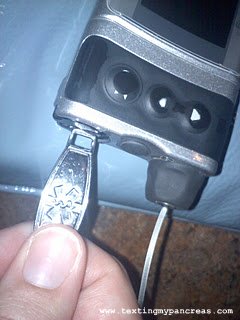
Guess who I'll be calling today? (Luckily I was able to pop that disc back in and it is still taking readings, but the functionality is, as they say, "wonky".)


Tuesday, April 16, 2013

Clean Off.

It appears that I should really be more careful when approaching chairs with unforgiving arm rests....

Related Posts Plugin for WordPress, Blogger...

While the Flexifix tape did its job of keeping my three day old Dexcom sensor's adhesive stuck to me, the actual sensor ripped almost clean off. Part of the wire might still be in my skin; I couldn't tell, but the wire looked shorter than normal to me after I removed it.

I guess we'll find out the next time I'm at the airport?